
The Essential Guide to Palm Springs Short-Term Rental Rules
Introduction
If you own a piece of Palm Springs mid-century magic—or you’re dreaming about buying one—there’s a good chance a short-term rental is somewhere in your game plan. I get it. Renting out your Meiselman for a few weekends a year (or turning it into a full-blown vacation rental business) sounds like a dream. But here’s the thing: Palm Springs takes its short-term rental rules seriously, and if you don’t know the playbook, you can find yourself in hot water fast.
Susan and I have lived this firsthand with our own home, so I wanted to break down exactly what you need to know—no legalese, just the real talk. Let’s dig in.
First Things First: What Even Counts as a “Vacation Rental” Here?
In Palm Springs, a vacation rental is any home rented out for 28 consecutive days or less where the owner isn’t present. If the owner is on-site during the guest’s stay, that’s technically called “homesharing” instead. Both fall under the same regulatory umbrella—Chapter 5.25 of the Palm Springs Municipal Code—but you’ll need to know which category your home falls into before you even think about listing it.
And here’s a big one: you cannot just decide to start renting your home short-term. You need a Vacation Rental Registration Certificate from the city first. Skip this step and you’re looking at serious consequences (more on that below).
Neighborhood Permit Caps: The Rule That Can Make or Break Your Plans
Everything discussed here is as of the writing of this article, but things change, so check the Palm Springs City website for the most up-to-date information.
Here’s one of the most important things to understand before you buy a Meiselman with a short-term rental in mind: not every neighborhood has room for a new permit.
What’s a “neighborhood” in Palm Springs? It’s not just a casual geographic area—it’s a legally defined boundary. The city recognizes 66 organized neighborhoods, and these boundaries are what the vacation rental ordinance uses when applying permit limits. These neighborhoods are defined by ONE-PS, the collective of recognized neighborhood organizations in the City of Palm Springs.
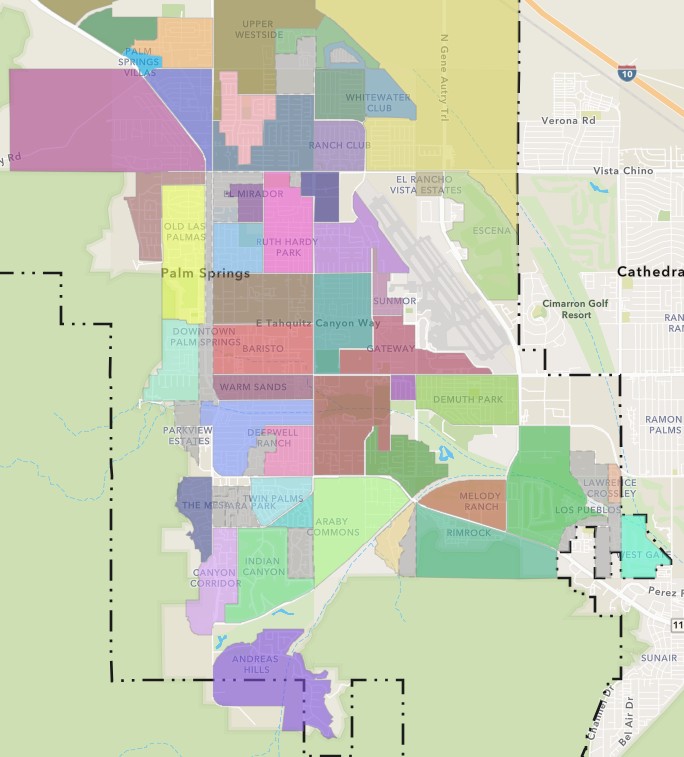
The 20% cap. Palm Springs enforces a neighborhood-level density cap: once vacation rental certificates equal 20% of the total dwelling units in a given neighborhood, the city stops issuing new standard certificates in that area.
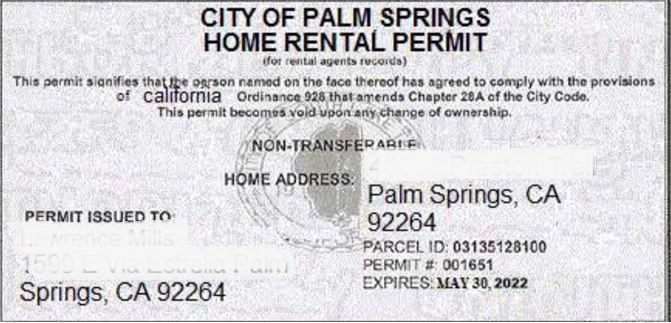
Permits are not transferable, and every owner must apply fresh. This is a detail that trips up a lot of buyers. A vacation rental certificate is tied to the individual owner, not the property—so when a home sells, the certificate does not go with it. The new owner has to file a brand-new application, even if the previous owner had a certificate in good standing for years. On top of that, certificates aren’t a one-and-done deal—they must be renewed every year, with updated insurance proof, HOA documentation, and a registration fee.
Existing permit holders get preference at renewal time. If a neighborhood’s percentage climbs above 20% after a certificate has already been issued, that existing owner isn’t denied renewal just because the neighborhood is now over the threshold. Their certificate stays valid and renewable year after year, as long as they stay in compliance. This grandfathering is exactly why you’ll see some neighborhoods sitting well above the 20% mark today—those permits were issued before the cap took effect or before the neighborhood crossed the line, and current owners keep renewing them.
The good news is that only 7 of the 66 neighborhoods are at or above the permit cap percentages, as shown below. Great neighborhoods like Sunrise Park, Little Beverly Hills, and Oasis del Sol are still available for short-term rental permits.
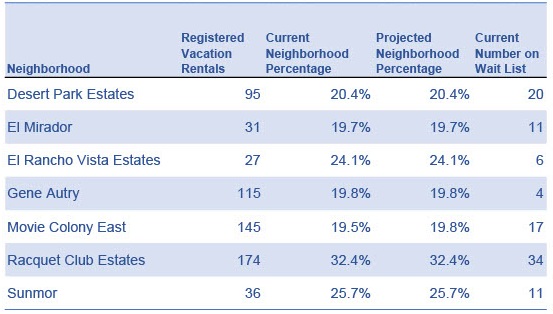
New applicants only get in when the neighborhood is below 20%. If you’re buying a home in a neighborhood that’s already at or above the cap, you cannot get a new certificate—full stop, regardless of what the previous owner held. Your only path in is to wait until the neighborhood’s percentage drops back below 20% (for example, if an existing permit holder lets their certificate lapse or sells and the new owner doesn’t pursue a permit). When that happens, the city works through a waitlist on a first-come, first-served basis, issuing new certificates to applicants in the order their complete applications were filed.
The takeaway for MCM buyers: if a short-term rental is part of your plan, check the current neighborhood percentage before you fall in love with a house. A seller’s existing permit does you no good—you’re starting from zero the moment escrow closes.
How Many Times a Year Can You Actually Rent It?
This is the “booking limit,” and it’s measured in contracts—city-speak for one signed guest stay, regardless of whether money changes hands. A contract includes any occupancy of the property by persons other than the owner when the owner isn’t present, whether or not compensation is paid or the stay is documented in a written agreement.
The numbers here have shifted over the past few years, so pay attention to your permit type:
- New permit holders: capped at 26 contracts per calendar year.
- Existing (grandfathered) permit holders: allowed 32 contracts annually, with up to four additional contracts permitted in the third quarter of the year—and the city recently walked back a planned reduction, since Ordinance 2118 removed an upcoming cut to the annual cap for existing permittees that would otherwise have taken effect January 1, 2026.
- Junior permits: a newer, lower-cost option capped at just six rental contracts a year, priced at roughly half the standard registration fee, and not counted against the neighborhood’s 20% cap—a nice option if you just want to rent occasionally without competing for a scarce full permit.
The Noise Ordinance: Quiet Desert, Loud Consequences
Palm Springs is famously protective of its peaceful, mountain-ringed neighborhoods, and the noise rules for vacation rentals are stricter than you might expect. The big one: vacation rental guests are subject to the same noise restrictions as any other Palm Springs resident, with two important exceptions—no amplified outdoor music is allowed at any volume, and indoor music can’t be audible from the property line, regardless of whether it exceeds decibel limits.
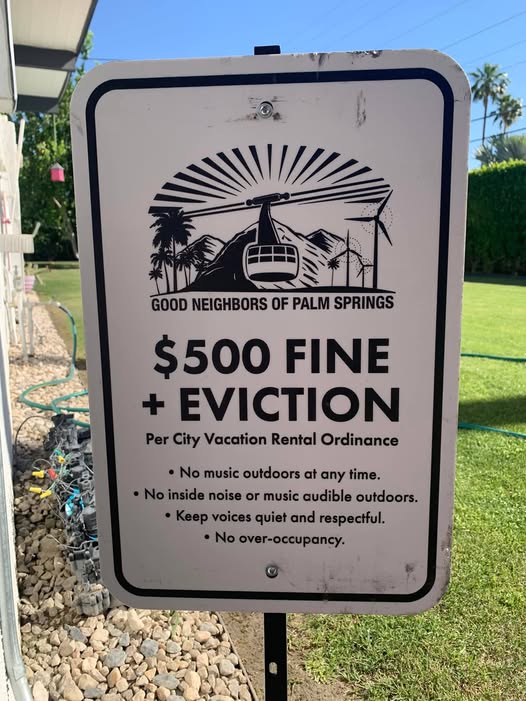
In plain English: that Bluetooth speaker on the patio can get you cited even if it’s not technically “loud” by any measurable standard. If your neighbors can hear it outside, it’s a violation.
Response Time: A Two-Tiered Clock
Every vacation rental must have a designated local contact—the owner, a property manager, or an authorized agent—available 24/7. Once the city’s enforcement official makes contact about a complaint, that local contact is required to respond by telephone within 15 minutes of a complaint coming through the hotline, and then respond in person within 30 minutes to any additional or successive complaints about the same property.
Fines and Penalties for Noise Violations: Who Actually Pays?
This is the part a lot of owners overlook, so let’s be precise about it.
The fine amount: Noise, music, trash, and other on-property nuisance citations carry an administrative citation of $500 for a first violation and $1,000 for each subsequent violation.
Who’s on the hook: Per the current municipal code, every administrative citation issued under this chapter is levied and assessed against the owner, not the guest. Even though it’s your guests making the noise, the certificate holder is the one who’s legally and financially responsible. City responders may make contact with guests on-site (and often just counsel them or leave a copy of the city’s Good Neighbor brochure), but the citation itself—and the fine—lands on the property owner’s account.
That’s exactly why the local-contact response time matters so much. A fast, effective local contact who can calm things down before a second complaint comes in isn’t just good neighborliness—it’s what stands between you and an escalating fine, and between your property and a “strike.”
The three-strikes rule: Rack up three citations (of any kind, not just noise) against your property in any 12-month period, and the city manager suspends your vacation registration certificate for two years. During that suspension, the property can’t be rented short-term at all—full stop.
One more wrinkle worth knowing: filing a knowingly false noise or nuisance complaint against a vacation rental or its guests is itself a citable offense under city code—so the accountability runs both directions.
The Takeaway for MCM Owners
None of this is meant to scare you off owning a Meiselman as a vacation rental—Susan and I have made it work beautifully with our home in the Oasis del Sol neighborhood through Acme House Company. But Palm Springs has built one of the most tightly regulated STR markets in California, and the owners who thrive here are the ones who treat compliance as part of the job, not an afterthought.
Before you buy with STR income in mind, check the neighborhood’s current permit percentage, remember that any existing permit dies with the sale, and build a rock-solid local response plan so you’re never scrambling when that clock starts ticking.
Want to dig into what makes a specific Meiselman home special—architecturally and as an investment? Head over to meiselmanregistry.org to explore our documented properties, and follow us on Instagram @meiselmanregistry for more.
FAQ: Palm Springs Short-Term Rental Rules
If I buy a Meiselman that already has an active vacation rental permit, do I inherit it? No. Certificates are tied to the individual owner, not the property. When a home sells, the certificate does not transfer—you have to apply for a brand-new one, even in a neighborhood that’s already over the 20% cap.
How often do I need to renew my permit? Every year, with updated proof of insurance, HOA documentation, and payment of the annual registration fee.
What if my neighborhood is already above the 20% cap—can I still renew my existing permit? Yes. Existing certificate holders aren’t denied renewal just because the neighborhood later exceeds the cap. That protection applies to renewals of your own existing permit—it does not extend to a new owner or a new applicant.
How do new applicants get a permit in a capped neighborhood? They wait. Once a neighborhood’s percentage drops back below 20%, new applications are processed in the order they were filed—first come, first served.
Is my noise fine my guests’ problem or mine? Yours. Administrative citations under the vacation rental ordinance are levied against the property owner, regardless of who actually caused the disturbance.
How fast does my local contact really need to respond? Two tiers: 15 minutes by phone after the first complaint comes through the hotline, and 30 minutes in person if additional or repeat complaints follow about the same property.
How much is the fine for a first noise violation? $500, billed to the property owner. A second noise/nuisance violation jumps to $1,000.
How much is the fine for advertising without my certificate number? $2,500, plus a six-month suspension of your certificate, for a first offense. A second offense is $5,000 and permanent revocation.
What happens if I operate without a certificate at all? A $5,000 fine and permanent ineligibility to ever hold a Palm Springs vacation rental permit. Continued operation after that escalates to $10,000 and beyond.
How many violations before I lose my permit entirely? Three citations of any kind within a rolling 12-month period trigger an automatic two-year suspension of your certificate.
Does the neighborhood cap apply to junior permits? No. Junior permits—capped at six contracts a year and priced at roughly half the standard registration fee—don’t count against a neighborhood’s 20% density cap.
A quick note: STR regulations change often in Palm Springs—always confirm current requirements directly with the City of Palm Springs Vacation Rental Compliance Department before making decisions based on this article.
Leave a Reply