
Is a Meiselman Home in Palm Springs a Good Investment?
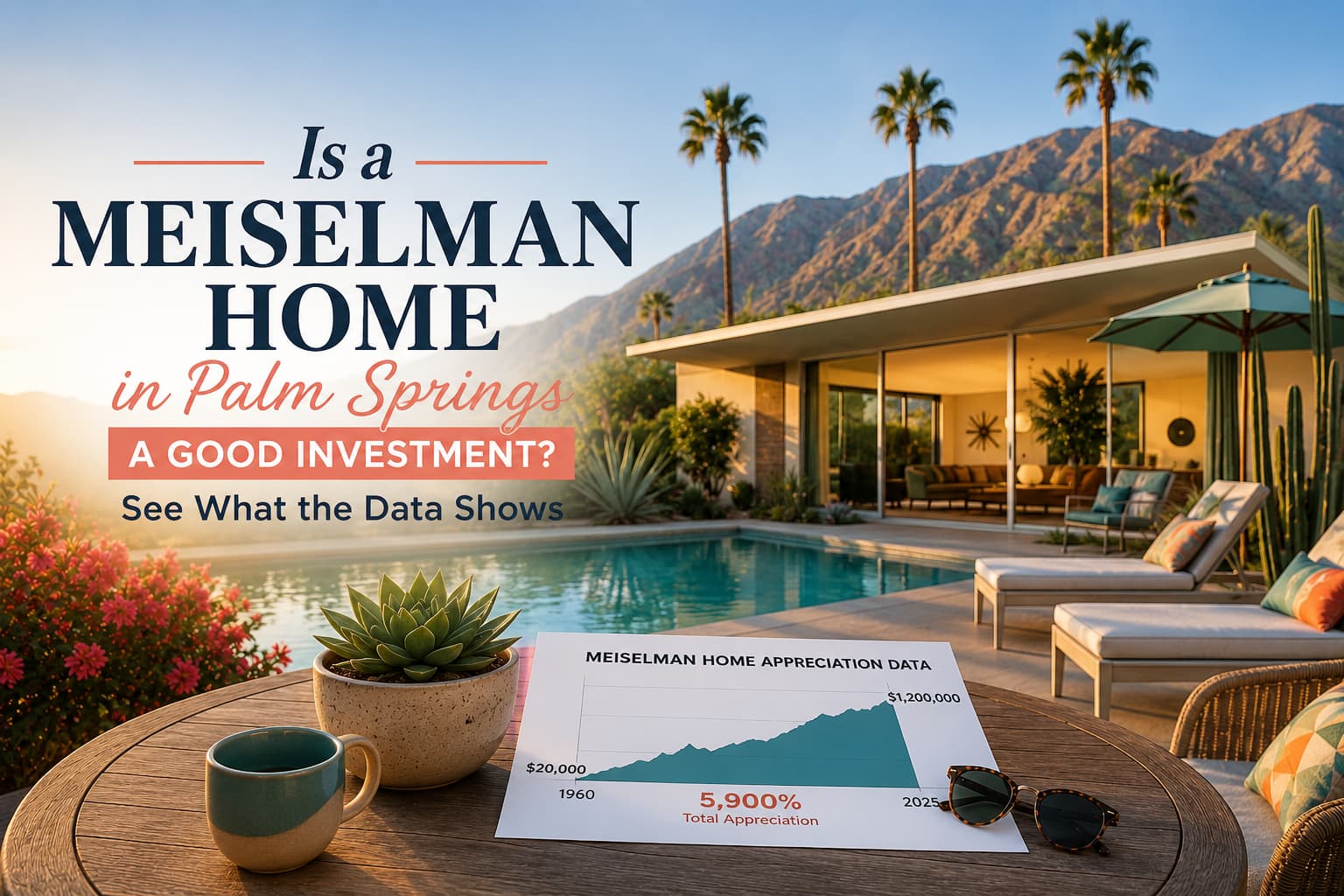
If you’ve ever stood in the living room of a Meiselman original — glass wall slid open, mountains framed like a piece of art — you already know these homes are special. But if you’re weighing a purchase (or just love an excuse to nerd out on real estate data), you’re probably asking the practical question too: is Palm Springs a smart place to put your money?
We went digging through the numbers, and the short answer is a pretty resounding yes. Let’s break down what the data actually shows — and why it matters for anyone thinking about buying a Meiselman home.
Caveat: This Data Isn’t Meiselman-Specific
Full transparency: the market data below tracks Palm Springs as a whole, not Meiselman homes in particular. Nobody’s running a dedicated real estate appreciation index for the roughly 300 homes scattered across a handful of neighborhoods (though hey, if someone wants to fund that research, we’re game).
But here’s the thing — a rising tide floats all boats. When the overall Palm Springs real estate market is this strong, it lifts every well-located, well-preserved midcentury modern home that makes Palm Springs so unique. And given that Meiselman homes sit in some of the city’s most sought-after MCM neighborhoods — Racquet Club Estates, Sunrise Park, Oasis del Sol, Little Beverly Hills — they’re positioned to benefit from that tide more than most.
Palm Springs Has Been One of the Best Long-Term Real Estate Bets in America
Let’s start with the headline number: over the last ten years, Palm Springs real estate appreciated 122.69%, or an average annual rate of 8.34% — putting it in the top 20% of communities nationally for real estate appreciation. Zoom out even further, and the picture gets more dramatic — since 2000, the city has seen 387.36% total appreciation, an average annual rate of 6.28%.
Here’s how that appreciation breaks down across time periods:
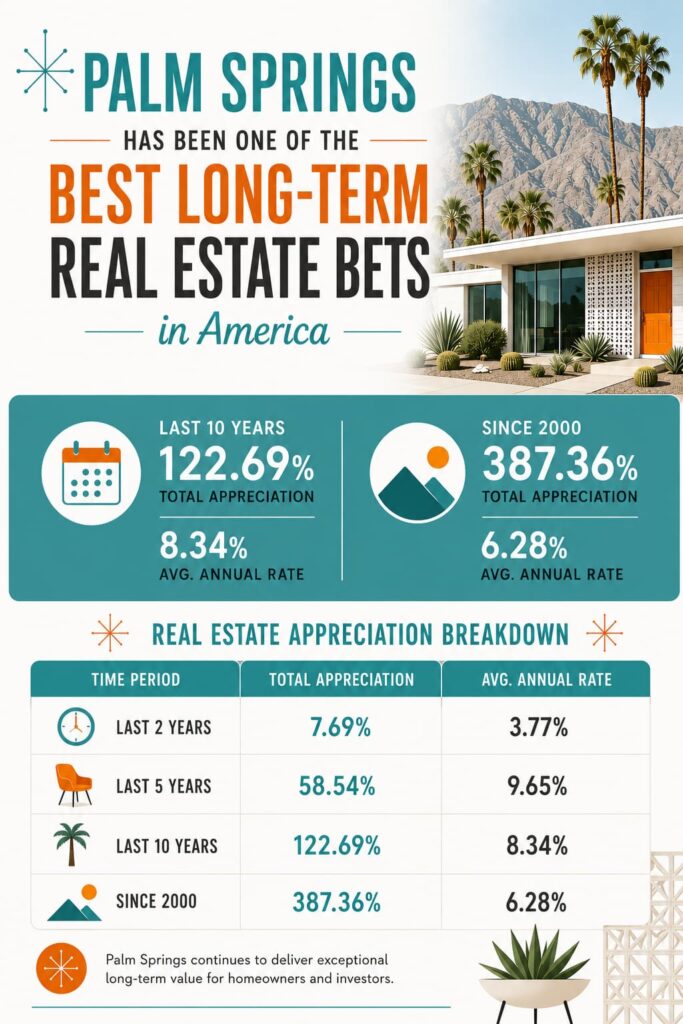
| Time Period | Total Appreciation | Avg. Annual Rate |
| Last 2 Years | 7.69% | 3.77% |
| Last 5 Years | 58.54% | 9.65% |
| Last 10 Years | 122.69% | 8.34% |
| Since 2000 | 387.36% | 6.28% |
Source: NeighborhoodScout, Palm Springs Real Estate Market Data
NeighborhoodScout describes Palm Springs as having a track record of being one of the best long-term real estate investments in America over the last decade. That’s not marketing spin from a listing agent — that’s a third-party data provider that tracks real estate transactions in basically every city and town in the country.
A Real-World Example: What 66 Years of Appreciation Actually Looks Like
Numbers on a chart are one thing. Here’s what that kind of appreciation looks like when you follow a single home across its lifetime.
Our neighbor Judith and her husband bought a Meiselman home in 1960 for $20,000. She’s just celebrated her 90th birthday. Her children have listed her house for $1,200,000. So, here’s the math on what Judith’s return on investment looks like:
| Metric | Value |
| Original sale price (1960) | $20,000 |
| Current value | $1,200,000 |
| Total appreciation | 5,900% |
| Years held | 66 |
| Average annual appreciation rate | ~6.4% |
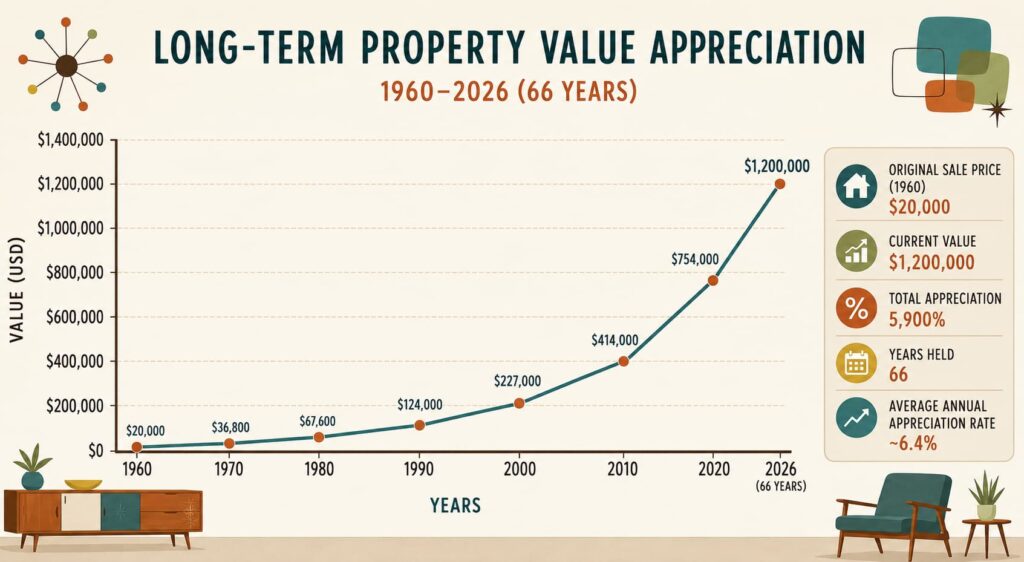
That works out to a compound annual growth rate of roughly 6.4% — which lines up almost perfectly with the 6.28% annual rate NeighborhoodScout reports for Palm Springs since 2000. In other words, the citywide data and a real 66-year ownership timeline tell the exact same story: slow, steady, compounding gains that turn into something enormous when you zoom out far enough.
That 5,900% figure looks almost unbelievable in isolation — but it’s simply what a 6-7% annual growth rate does when it compounds, uninterrupted, over six decades. It’s a good reminder that you don’t need a red-hot market to build serious long-term wealth in real estate. You just need patience and a house worth holding onto.
Top Three on the Scale — Both in California and Nationally
Here’s where it gets really interesting. NeighborhoodScout ranks every city’s appreciation performance on a 1–10 scale (10 being the top tier) — once compared against other California communities, and once against the entire nation. Palm Springs’ scores land in the top three rungs of that scale across every meaningful time horizon:
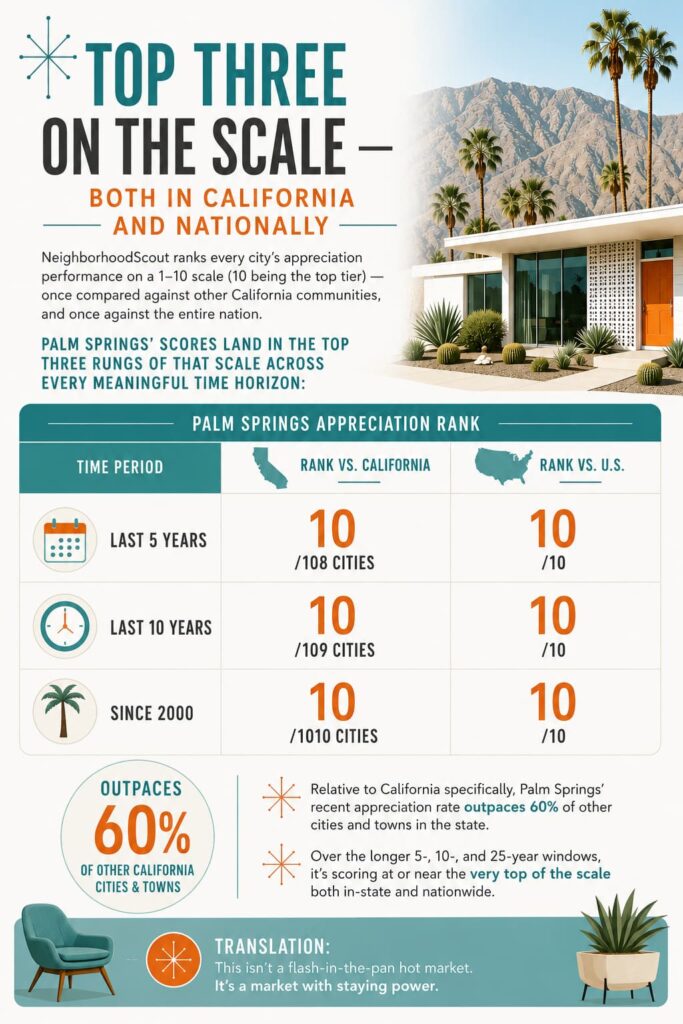
Relative to California specifically, Palm Springs’ recent appreciation rate outpaces 60% of other cities and towns in the state. Over the longer 5-, 10-, and 25-year windows, it’s scoring at or near the very top of the scale both in-state and nationwide. Translation: this isn’t a flash-in-the-pan hot market. It’s a market with staying power.
What About the Short Term?
Worth noting — appreciation has cooled recently. Over the last twelve months, Palm Springs appreciated just 1.43%, trailing most communities in the country, and the most recent quarter actually dipped slightly, at -0.42%. That’s a normal market correction after a red-hot five-year run that spiked during COVID. Real estate markets rarely move in a straight line, and the 5- and 10-year trendlines still tell a very healthy story.
The Fundamentals Behind the Numbers
A few other data points worth knowing if you’re thinking long-term:
- Median home value: $715,089, reflecting a market with real, sustained demand — not a bargain-basement bet, but also still affordable.
- Average market rent: $3,566 per month, and $385/day, for a three-bedroom home, which matters a lot if you’re weighing a Meiselman home as a vacation rental. Daily rates can be over $900/day during peak periods, like Modernism Week or Coachella.
- Homeownership rate: 64.8%, with the remainder renting — a healthy owner-occupied base that tends to support long-term price stability.
So — Is a Meiselman Home a Good Investment?
Based on market data, Palm Springs has been, and continues to be, one of the strongest long-term real estate stories in the country. And Meiselman homes aren’t just riding that citywide wave — prime examples of what make the Palm Springs market so unique.
FAQs – Frequently Asked Questions
Has Palm Springs real estate appreciated well over the last decade? Yes — Palm Springs home values rose 122.69% over the last ten years, an average annual rate of 8.34%, according to NeighborhoodScout.
How does Palm Springs compare to the rest of California for home appreciation? Palm Springs scores a 10 out of 10 on NeighborhoodScout’s California comparison scale for 5-year, 10-year, and since-2000 appreciation — making it among the top-performing markets in the state.
What would a home bought in 1960 for $20,000 be worth today? Using a real-world example, a MCM–era home purchased for $20,000 in 1960 and that has been fully restored, is now valued at $1,200,000. This represents a total appreciation of 5,900% — an average annual compound growth rate of about 6.4% — closely tracking the city’s long-term appreciation trend.
Is now a good time to buy in Palm Springs? Prices surged during COVID and have returned to normal, so now is a good time to buy. Long-term data (5-, 10-, and 25-year) continues to show Palm Springs as one of the top-ranked appreciation markets in the country.
Curious what a Meiselman original looks like in person? Explore documented properties at meiselmanregistry.org and follow along @meiselmanregistry on Instagram.
Data source for all statistics: NeighborhoodScout — Palm Springs, CA Real Estate Appreciation & Housing Market Trends, Q4 2025 data.
Leave a Reply