
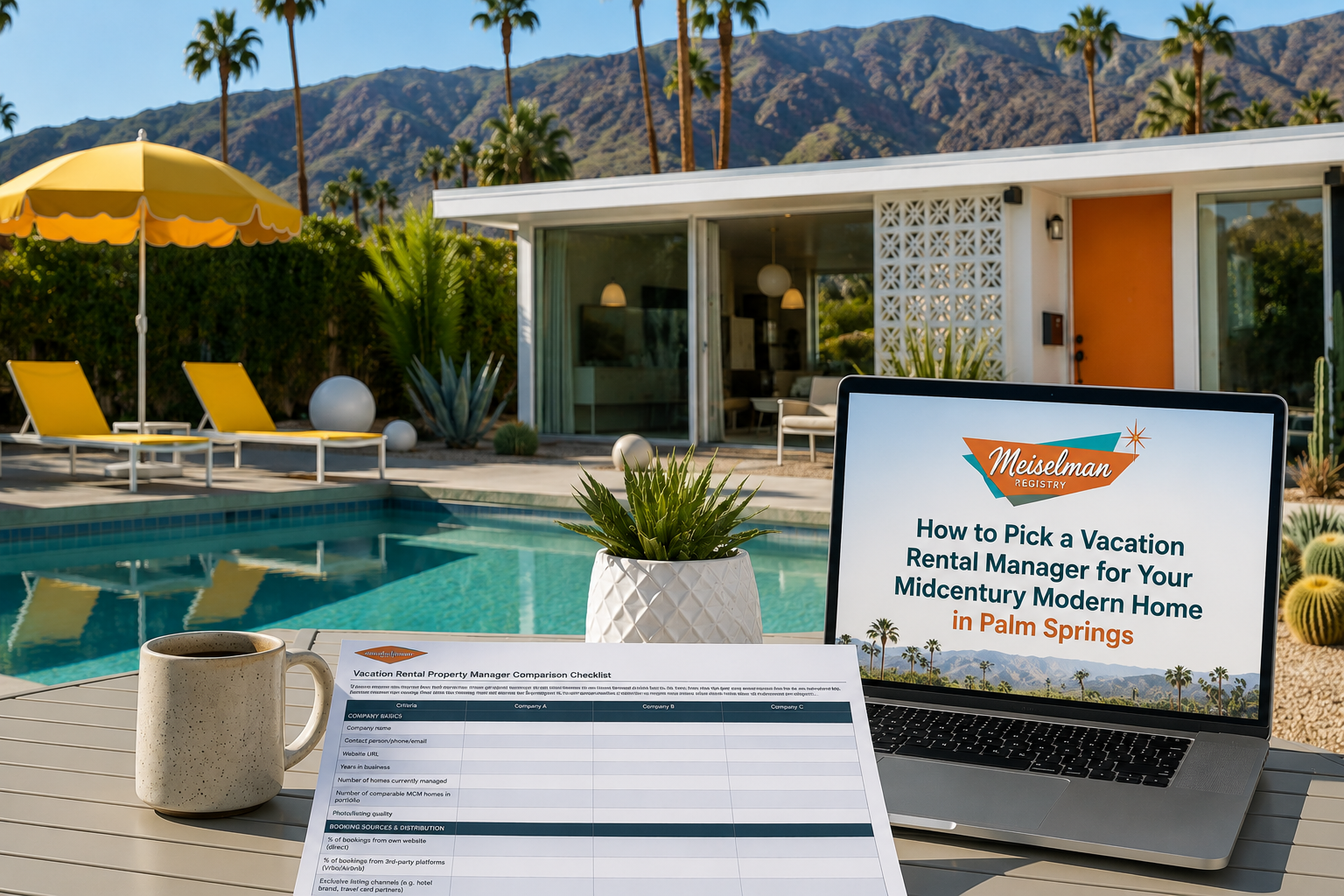
How to Pick a Vacation Rental Manager for Your Midcentury Modern Home in Palm Springs
TL;DR
Choosing a property manager isn’t just about who has the flashiest pitch deck. Look at their portfolio, where their bookings come from, their occupancy rate numbers, how long do clients stay, what you’ll pay upfront and monthly, their commission structure, and their guest review scores. Just as important: read the actual contract. We went through this whole process for our vacation rental home in Palm Springs and selected Acme House Company — they’ve been great for occupancy and speed-to-first-booking, but they’re more expensive than everybody else in town. Worth it? For us, yes. Here’s how we made that call, and what we’d tell any owner to look for.
Make Your Decision Based on Market Data
When we bought our midcentury modern home in Palm Springs, we didn’t know anything about how to pick the right vacation property manager to help us. There are dozens of companies in Palm Springs, all promising to fill your calendar and treat your home like their own, and honestly, a lot of the sales pitches sound identical. So we did what any reasonably obsessive homeowners would do: we made spreadsheets, asked a ton of nosy questions, and talked to other owners who’d already been through the process. Here’s what we discovered.
1. Do They Already “Get” Midcentury Homes?
This one was non-negotiable for us. We wanted a property manager who focused exclusively on renting midcentury modern homes, not someone who has a mixed portfolio of MCM, hacienda, ranch, and newly built homes. Check out their portfolio online and see what kind of vibe it gives you. If they’ve got lots of MCM homes, that tells you they know how to photograph and market design-forward homes, and they probably already have a built-in audience of design lovers who search specifically for homes like yours.
2. Website Quality Isn’t Aesthetics — It’s Revenue
In the vacation rental business, a company’s website shouldn’t just be an online brochure. It should be a sales engine, designed to make it compelling and easy for guests to book a rental. A clean, fast, mobile-friendly site with great photography, easy property filtering, and an easy booking flow converts into more direct bookings, which is what matters. Poke around their site as a potential guest would. Is it easy to find availability? Does it load fast on your phone? Does it make the home look the kind of place you would pay $500+ a night to stay in?
3. Where Do Their Bookings Actually Come From?
This is the question most owners forget to ask, and it’s a big one. Ask any company you’re considering: what percentage of your bookings come through your own website versus third-party platforms like Vrbo or Airbnb?
Third-party platforms take their own cut on top of whatever commission your manager charges, which either eats into your revenue or gets passed along to guests as higher rates. A manager who’s built a strong direct-booking engine through their own site and repeat/referral guests is generally running a leaner, more profitable operation. Also, ask whether they have access to any exclusive listing channels — some managers have partnerships with hotel brands or premium travel-card portals that widen the pool of qualified guests.
4. Ask for Real Performance Numbers
Don’t accept vague answers like “we outperform our competition.” Ask for:
- Average annual occupancy rate for homes like yours
- Average daily rate (ADR) they’re achieving
- RevPAR (Revenue Per Available Rental). This blends occupancy and rate into one number, making it easier to compare managers with different pricing strategies
- Portfolio performance overview of all their homes over the last 12 months, if they’ll share it
Run the math yourselves: occupancy rate × ADR × 365 gives a rough estimate of gross revenue before fees.
5. How Long Do Owners Actually Stay?
Average client tenure is a sneaky-good indicator of trustworthiness. Ask directly: “What’s your average client retention?” It’s also worth asking about their guest repeat/return rate — a separate metric that reflects how satisfied travelers are, which is a decent proxy for how they’ll treat your property.
6. Startup Costs and Ongoing Expenses
Get a full, itemized breakdown before you sign anything. Costs generally fall into two buckets: fixed onboarding costs (smart-home hardware, professional photography, listing assets) and variable/startup costs (initial safety inspection, pre-arrival deep clean, amenity stocking). Then there are the ongoing costs: management commission (typically 20–35% of booking revenue), turnover cleaning, maintenance, linen replenishment, marketing/listing fees, and, sometimes, a credit card processing surcharge. Some managers bundle recurring costs into one flat monthly fee; others itemize everything separately. Neither is inherently better, but make sure you compare the same list of services across quotes.
7. Guest Reviews (and Guest Satisfaction) Reflect On You, Too
Check average review scores and read a few reviews, not just the star rating. Some companies also track a Net Promoter Score (NPS), which measures overall guest satisfaction — worth asking about since it can be a more nuanced signal than star ratings alone.
8. Read the Contract Closely — This Is Where the Real Terms Live
This is the step we’d tell every owner not to skip. The marketing brochure tells you the story a company wants you to hear; the actual management agreement tells you what you’re legally on the hook for. When we signed ours, a few clauses stood out as things every owner should understand, regardless of which company you go with:
Tiered commission structures. Our agreement charges one commission rate (30%) on bookings the manager drives through their own channels, and a lower rate (20%) on bookings we refer ourselves. If you expect to send friends or repeat guests the manager’s way, ask whether owner-referred bookings get a reduced rate — it’s a meaningful distinction that doesn’t always show up in the sales pitch.
Forward availability requirements. Many agreements require the home to remain bookable for a set number of months out. Ours initially requires 12 months of forward availability and at least 6 months on a rolling basis thereafter. This matters because if you terminate the agreement or fail to honor a confirmed reservation that falls within that window, you can be liable for the manager’s commission on those dates plus relocation costs for displaced guests. Understand this clause before you sign — it affects how easily you can exit or sell.
What happens if you sell the home? If you list your property for sale, most agreements require you to notify the manager, and if the new owner won’t honor outstanding reservations, you (the seller) can remain liable for the costs described above. If you think you might sell within a few years, ask specifically how existing bookings are handled during a transition.
Damage waiver vs. security deposit. Instead of collecting a security deposit from guests, our agreement uses a damage waiver: guests pay a small fee, and the manager covers guest-caused damage up to a set limit (in our case, $5,000) at no additional cost to us. The waiver fee is retained by the manager, not paid to us, and we’re on our own for pursuing costs above that limit. Ask what the coverage limit is and who’s responsible for damage beyond it.
Owner indemnification. Most agreements require the owner to indemnify the manager against claims related to the property or guest occupancy, except in cases of the manager’s gross negligence or willful misconduct. In practice, this means your own liability insurance is doing most of the heavy lifting, which leads directly to the next point.
Insurance minimums. Ours requires a specific short-term rental (commercial) policy — not just a homeowner’s policy with an endorsement — with at least $500,000 in commercial liability coverage, plus proof that the management company is named as an additional insured in a very specific format. Standard homeowner’s policies often exclude business use entirely, so this is worth a serious conversation with an insurance broker before you sign anything, regardless of which manager you choose.
Financial reserve and account terms. Our agreement requires us to keep a positive balance in our owner account (with a required reserve of $500), and if the balance runs short, the manager can charge a card on file — sometimes with a surcharge. Ask how the reserve requirement works and what happens if there’s a shortfall during a slow season.
Dispute resolution. Ours funnels disagreements through negotiation first, then small court claims for amounts under $7,500, and binding arbitration for anything above that — meaning we’ve largely waived our right to sue in regular court for bigger disputes. This is standard in the industry, but it’s worth knowing going in.
None of this is unique to any one company — it’s the kind of fine print that shows up across the industry. But it’s exactly the stuff that’s easy to skim past when you’re excited about a shiny brochure and strong occupancy numbers. We’d encourage every owner to read the actual agreement start to finish, ideally with a lawyer, before signing.
Our Own Experience
For what it’s worth, we went with Acme House Company for our place. Their commission runs around 30% on manager-driven bookings, which is on the higher end of the survey. We saw quotes closer to 20% elsewhere in town. But our home rented fast right out of the gate, occupancy has stayed strong, and their direct-booking percentage was noticeably higher than what other companies quoted us. For us, the performance justified the premium, and we felt comfortable with the contract terms once we understood them. That’s a calculation only you can make based on your home, risk tolerance, and financial goals. Don’t just take our word for it — get quotes and contracts from a few companies, read them carefully, and weigh them all yourselves.
CTA
Download our FREE Vacation Property Manager Checklist to help you evaluate managers for your short-term rental property.
FAQ
How many property management companies should we interview before deciding?
Talk to at least three. It gives you enough data points to spot real differences in pricing, communication style, and performance claims.
Is a lower commission always the better deal?
Not necessarily. A company charging a slightly higher commission but delivering much higher occupancy, ADR, or RevPAR can easily out-earn a “cheaper” option. Always look at net revenue after fees.
What’s a “forward availability” requirement, and why does it matter?
It’s a contractual requirement that your home stay be bookable for a certain number of months into the future. If you terminate early or block dates within that window, you may owe the manager commission and other costs for bookings you disrupt. Ask about this before signing up, especially if you might sell the home.
Do we need special insurance for a vacation rental?
Almost certainly yes. Standard homeowner’s policies often exclude business use, including short-term rental. Talk to a licensed insurance broker about a dedicated short-term rental (commercial) policy before your home goes live.
How important are guest reviews really?
Very. They directly affect future bookings and search ranking on major platforms, and they’re a solid proxy for day-to-day guest service quality.
Can we change property managers later if we’re not happy?
Usually yes, with proper notice — but check the forward-availability and termination clauses first, since you may remain liable for existing bookings within that window even after you switch.
Leave a Reply