
Desert Park Estates: Palm Springs’ Unsung MCM Treasure
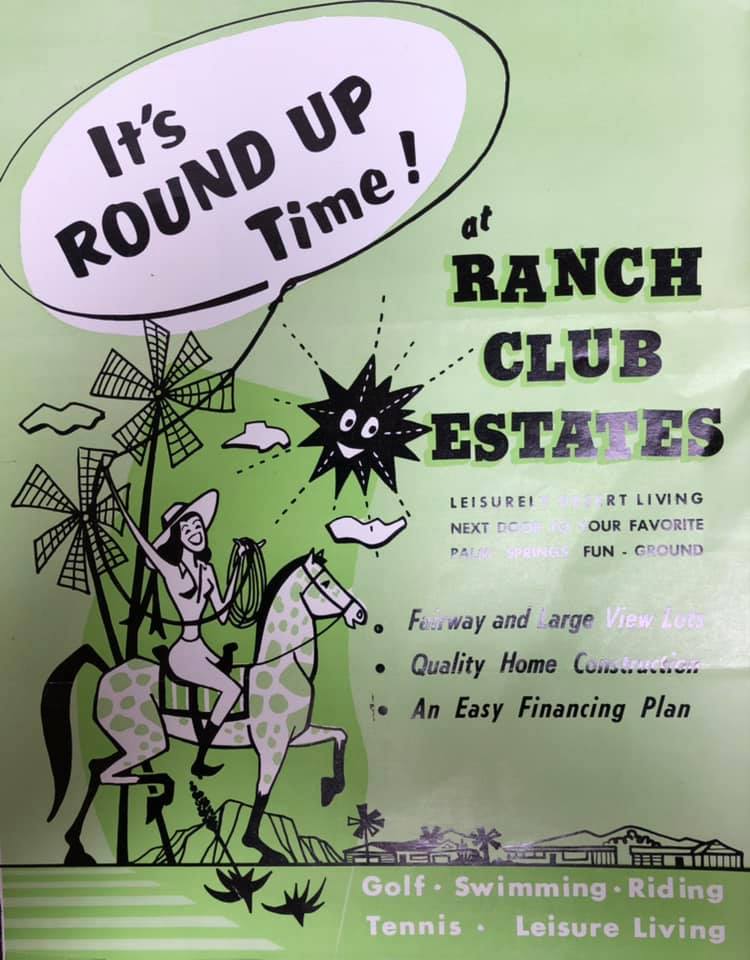
If you’ve ever driven north on Indian Canyon Drive past the airport, you’ve passed right through one of Palm Springs’ most interesting — and most underrated — midcentury modern neighborhoods. But honestly? I think that’s part of its charm.
I’ve been digging into the history of this neighborhood for the Meiselman Registry, and the more I learn, the more I appreciate it. So let’s take a deep dive into Desert Park Estates: who built it, and why it absolutely belongs in the conversation when we talk about Palm Springs’ midcentury modern legacy.
How It All Started: Noel Clarke and the Ranch Club
To understand Desert Park Estates, you have to start with Noel Clarke — and his Ranch Club. In the late 1950s, the Ranch Club was THE social hub of Palm Springs. It sprawled across a square mile of the city’s north end, and Clarke owned all of it. According to local Palm Springs sources, his club had more members than any other in the city at the time — which tells you something about how popular it was.
Clarke was smart enough to realize that all those members and their friends might also want to live nearby. So in the late 1950s, he transformed his land holdings — roughly 1,000 acres — into a pair of planned residential communities: Ranch Club Estates (immediately surrounding the club itself) and Desert Park Estates (spreading out further to the northeast). It was one of the most ambitious residential development projects in Palm Springs at the time.
“In the late 1950s, visionary Noel Clarke transformed 1,000 acres into the Ranch Club and Desert Park Estates.”
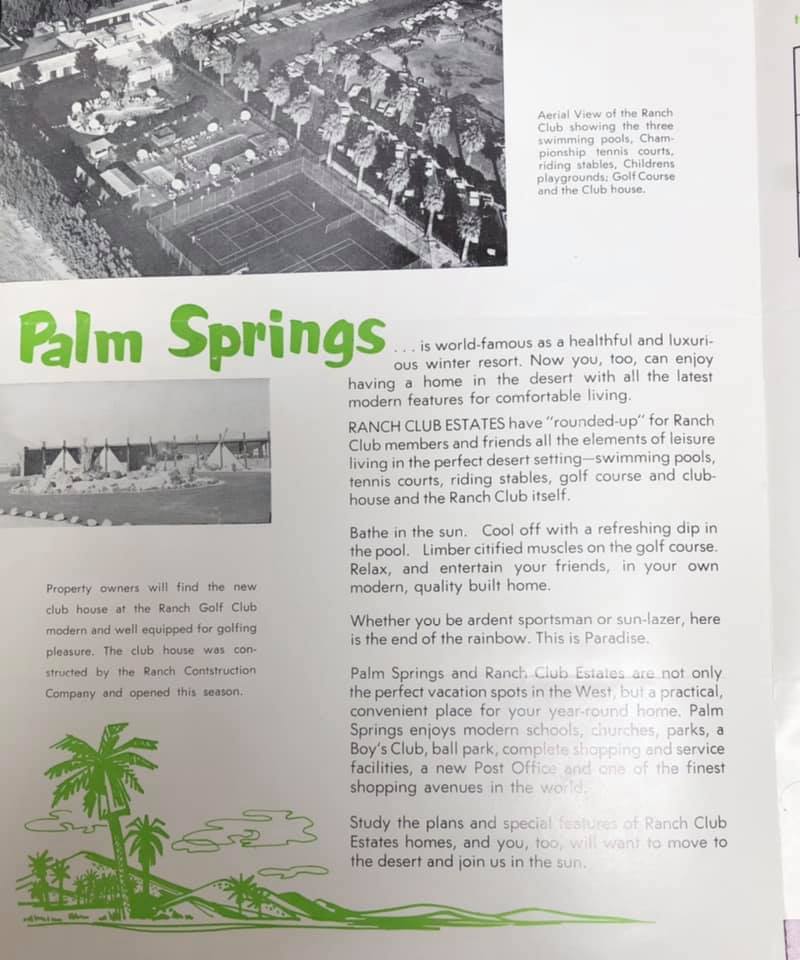
For the homes in Desert Park Estates, Clarke brought in developer Tom Sills and the Ranch Construction Company to build the tract. And for the architecture? He tapped a young designer who was just hitting his stride in the Palm Springs scene: Hugh Kaptur.
Hugh Kaptur and the Five Model Designs
Hugh Kaptur is one of the genuine legends of Desert Modernism, and Desert Park Estates is one of his most important early works. Born in Detroit in 1931, Kaptur studied architectural engineering at the Lawrence Institute of Technology before relocating to Palm Springs in 1956. He apprenticed with the firm of Wexler & Harrison before eventually going out on his own.
Kaptur designed three distinct model homes for the Desert Park Estates tract. I read that he gave them names straight out of a Western movie: the Saddle, the Sombrero, and the Spur. I love that. But I don’t see it in the official Desert Park Estates brochure.
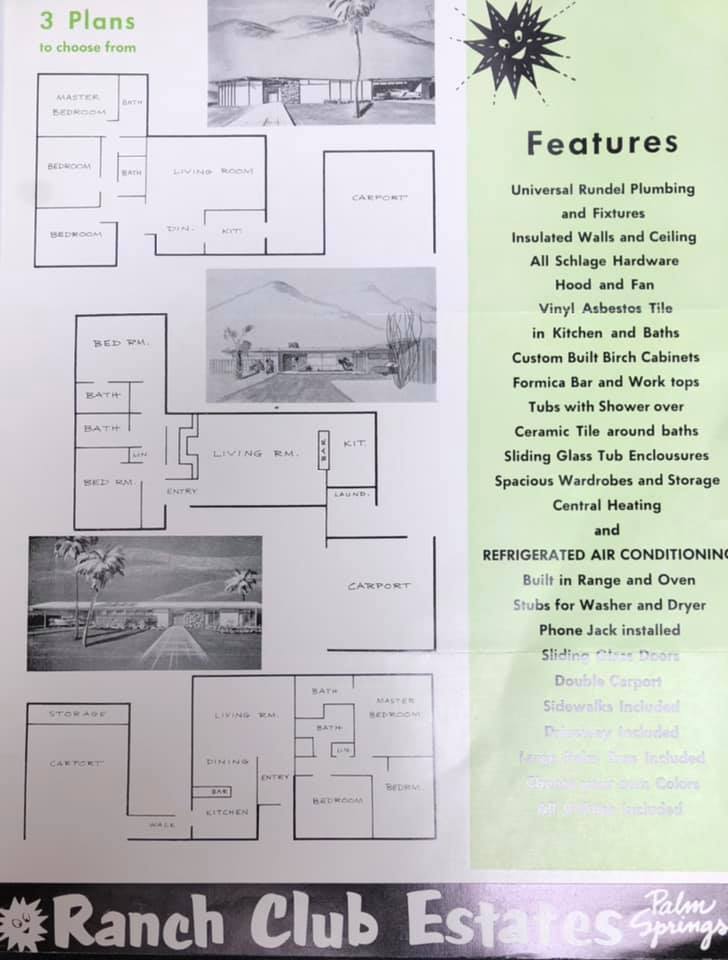
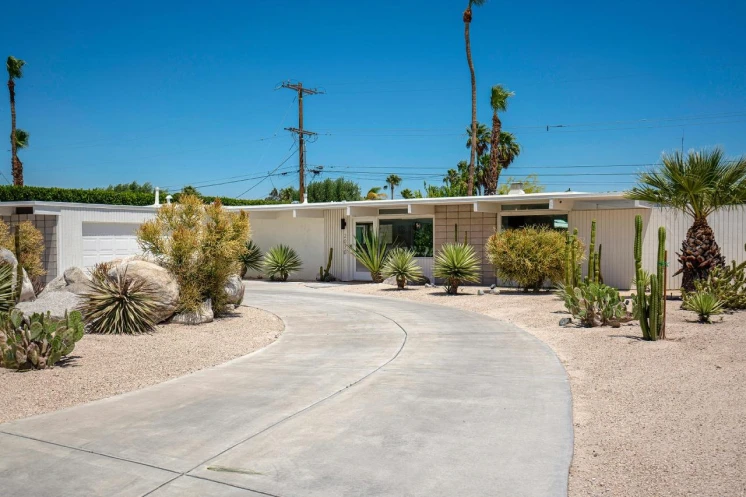
The homes were low-set, with gently sloped roofs, post-and-beam construction, and insulated ceilings — a smart response to the desert climate. The design language was clean and accessible: these weren’t showboating architectural experiments, they were thoughtfully resolved tract homes that happened to be beautiful. Kaptur designed approximately 30 midcentury homes in Desert Park Estates overall, many of which survive today.
Enter Jack Meiselman
Desert Park Estates wasn’t just Kaptur’s territory. Jack Meiselman was also active in this neighborhood.
Meiselman (1899–1994) and his wife Berne “Babe” Meiselman developed somewhere between 250 and 300 homes across Palm Springs during the late 1950s and through the 1960s. Their collaboration with architectural designer John “Jack” Moyer, produced homes that shared the same Desert Modernist DNA as the Alexander homes that dominated the era — post-and-beam construction, clerestory windows, butterfly roofs, walls of glass blurring the line between inside and out. But Meiselman homes have their own character: typically more intimate in scale, thoughtfully sited on the lot for mountain views, and notable for being among the first tract homes in Palm Springs to include central air conditioning and heating as standard equipment.
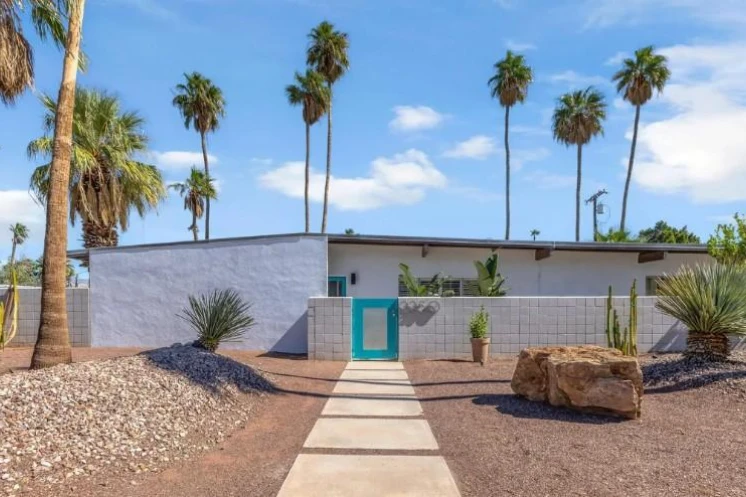
Meiselman’s homes are scattered across Desert Park Estates — and the Registry has documented a few of them, including examples at 2070 E. Nicola Road (1956) and 2250 Acacia Road E (1968). The 1956 build date at Nicola Road places it among the earliest documented Meiselman homes in the neighborhood.
“Most Meiselmans are scattered among Alexanders in neighborhoods including Racquet Club Estates, Sunmor, Sunrise Park, and Desert Park Estates.”
If you own or know of a Meiselman home in Desert Park Estates, we’d love to hear from you and include your home in our archive.
A Neighborhood That Wears Its Hollywood History on Its Street Signs
One of my favorite things about Desert Park Estates is how much history is literally embedded in the street names. Drive through the neighborhood and you’ll pass Farrell Drive (named for Charles Farrell, the 1920s and ’30s matinee idol who co-founded the Racquet Club in 1934 and later served as Mayor of Palm Springs), Bellamy Road (for his co-founder, actor Ralph Bellamy), and Powell Drive (for actor, William Powell of The Thin Man fame, who was a fixture at the Racquet Club for decades).
And then there’s the northernmost street in the neighborhood: Joyce Drive. That one’s a tribute to Joyce Clarke — the wife of developer Noel Clarke, the man who built the whole thing. It’s a sweet, personal touch in a neighborhood that otherwise reads like a Hollywood Walk of Fame.
As for the nearby Ranch Club itself, its legacy lives on too. One of its most storied chapters involves an unnamed retreat where Marilyn Monroe once reportedly slipped in through a secluded entrance to spend the night with John F. Kennedy.
What Desert Park Estates Looks Like Today
Today, Desert Park Estates is a genuinely mixed architectural neighborhood — midcentury modern, Spanish Revival, Mediterranean, ranch, and contemporary homes coexist on its streets. The construction period spans from the early 1950s all the way through the 2000s. Homes typically range from around 1,275 to 3,000 square feet on generous lots, most with room for a pool in the backyard (this is Palm Springs, after all).
One of the things that sets Desert Park Estates apart from much of Palm Springs is that all homes are on fee simple land — meaning you own the dirt under your house outright. No lease land arrangements, no quarterly ground rent payments, no tribal land leases. Also, there’s also no HOA.
The neighborhood has its own active civic organization, the Desert Park Estates Neighborhood Organization, which was certified by the City of Palm Springs in 2007. They installed their first blade street signs in 2013. It’s the kind of detail that tells you people here are invested in where they live.
Own a Meiselman Home in Desert Park Estates?
If you own or know of a Meiselman home in Desert Park Estates — whether it’s in the Registry or not — we’d love to hear from you. The Meiselman Registry is a free, community-powered archive, and every home we document helps preserve this remarkable chapter of Palm Springs history. Visit meiselmanregistry.org to explore the archive, claim your property listing, or just say hello.
Leave a Reply