
Racquet Club Estates: Where Hollywood Glamour Built a Neighborhood
Some neighborhoods are defined by their architecture. Some are defined by their location. Racquet Club Estates, tucked into the north end of Palm Springs between Vista Chino, Indian Canyon Drive, San Rafael, and Avenida Caballeros, is defined by both — plus a backstory soaked in more Hollywood glamour than almost any neighborhood in America. This is where mid-century modern design hit its full stride, where Jack Meiselman and the Alexanders built some of their most celebrated homes, and where a single famous tennis club cast a decades-long shadow of star power that still draws visitors today.
With nearly 550 single-family homes, Racquet Club Estates is quite possibly the largest neighborhood organization in all of Palm Springs. It’s also, by nearly any measure, the most architecturally consequential. Palm Springs is said to have the highest concentration of mid-century modern architecture in the United States — and Racquet Club Estates is its ground zero.
The Club That Started It All
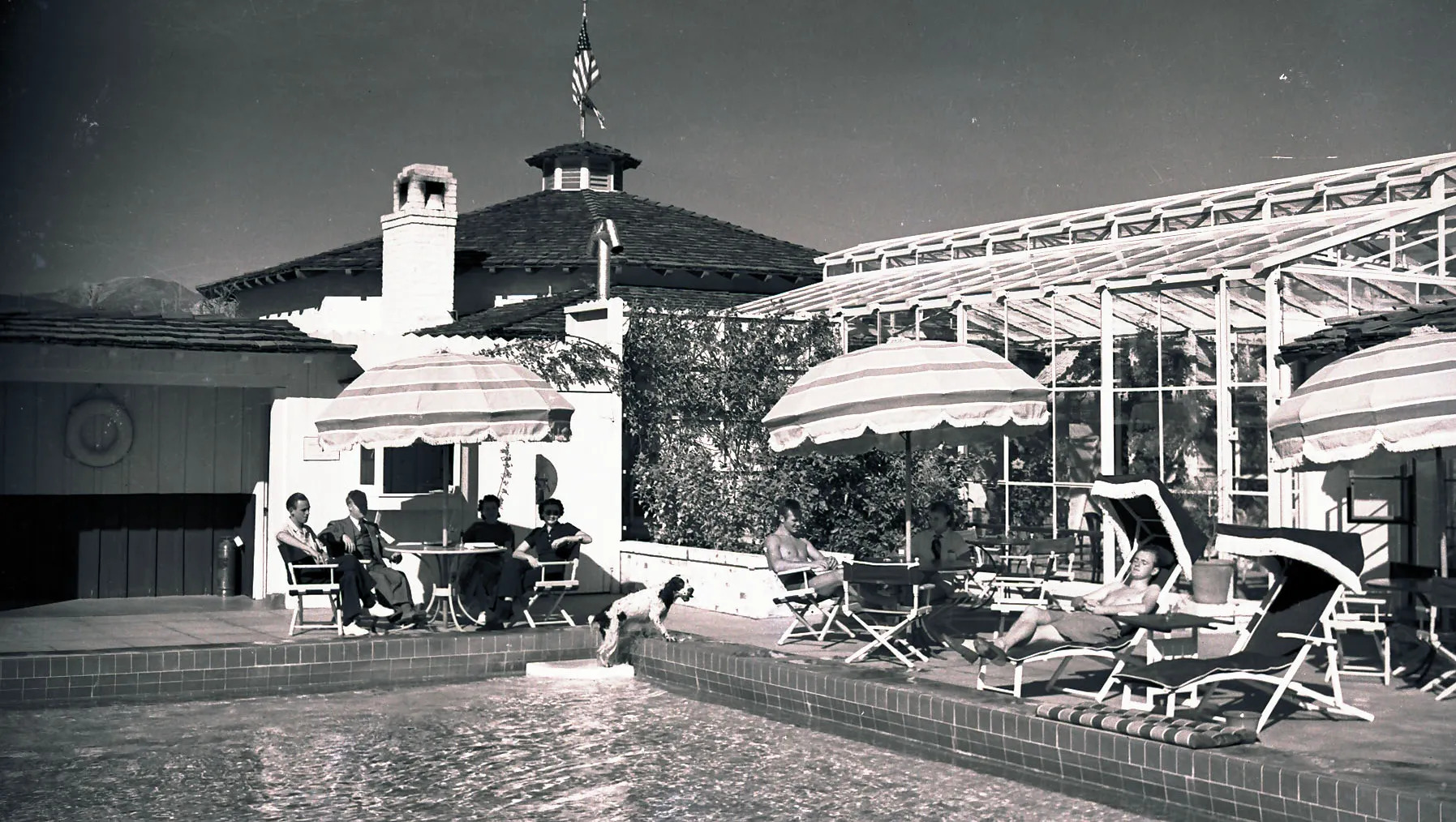
To understand Racquet Club Estates, you have to start with the club itself. In December 1934, actors Charlie Farrell and Ralph Bellamy opened the Palm Springs Racquet Club after purchasing roughly 200 acres of windswept desert land at just $30 an acre. Their original ambition was modest: build two great tennis courts for their Hollywood friends, who had been feuding with the El Mirador Hotel over court access. On opening day, they charged $1 per player — and took in all of $18. They were undaunted.
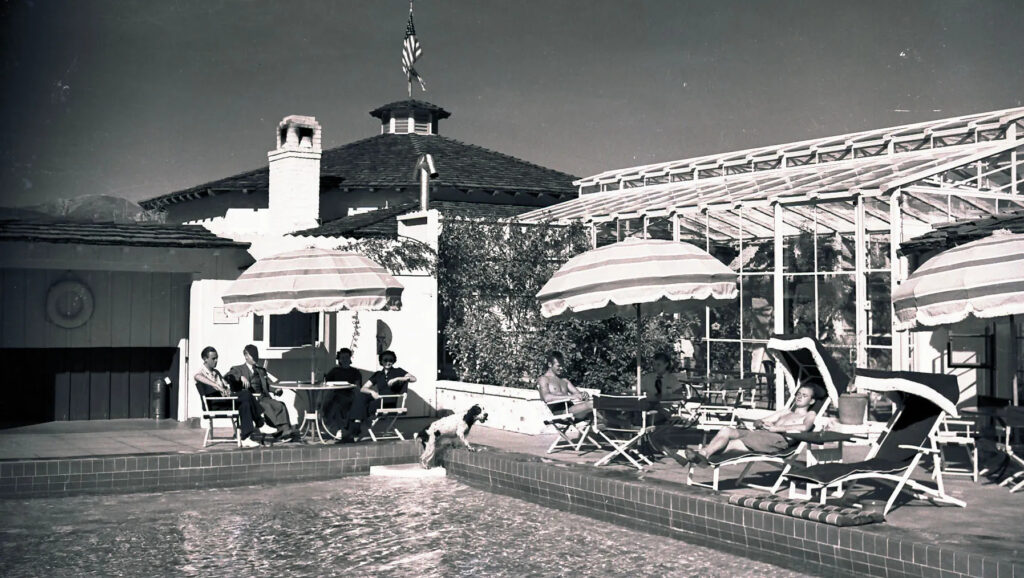
Word spread fast through Hollywood, and the club grew quickly into the desert’s most exclusive address. By the time the Bamboo Bar opened — designed by film director Mitch Leisen and said to be the world’s first bar constructed entirely from bamboo — the Racquet Club had become the worst-kept secret in show business.
Spencer Tracy lived in Bungalow No. 19 all winter. Frank Sinatra, Humphrey Bogart, Clark Gable, Marilyn Monroe, Lana Turner, Cary Grant, Audrey Hepburn, Errol Flynn, Ginger Rogers, and Joan Crawford were regulars. On any given New Year’s Eve, the place was, as one longtime member put it, “so crowded you could barely move” — and it was crowded with movie stars.
Marylin Monroe – A Star Discovered
One of the most consequential chapters in the club’s history unfolded poolside over two separate visits. In 1947, photographer Bruno Bernard first brought a young actress named Norma Jean Baker to the club for a photo shoot. Two years later, in 1949, he brought her back — and this time, Johnny Hyde noticed her. Hyde was no ordinary agent: he was the vice president of the William Morris Agency’s West Coast office, and one of the most powerful talent brokers in Hollywood. He took Monroe under his wing, and used his influence to secure her breakthrough roles in both The Asphalt Jungle and All About Eve — the one-two punch that launched her career and made the woman the world came to know as Marilyn Monroe a star.
The Alexanders Arrive: A Neighborhood Is Born
The residential neighborhood that would become Racquet Club Estates began taking shape in 1959, when the Alexander Construction Company launched what would become their single largest tract home development. George and Bob Alexander, who had already transformed the Palm Springs housing market with their work in Twin Palms and Vista Las Palmas, recognized the appeal of building near the city’s most glamorous address. Their target buyers were second-home purchasers and vacation-home seekers, many of them with Hollywood connections.
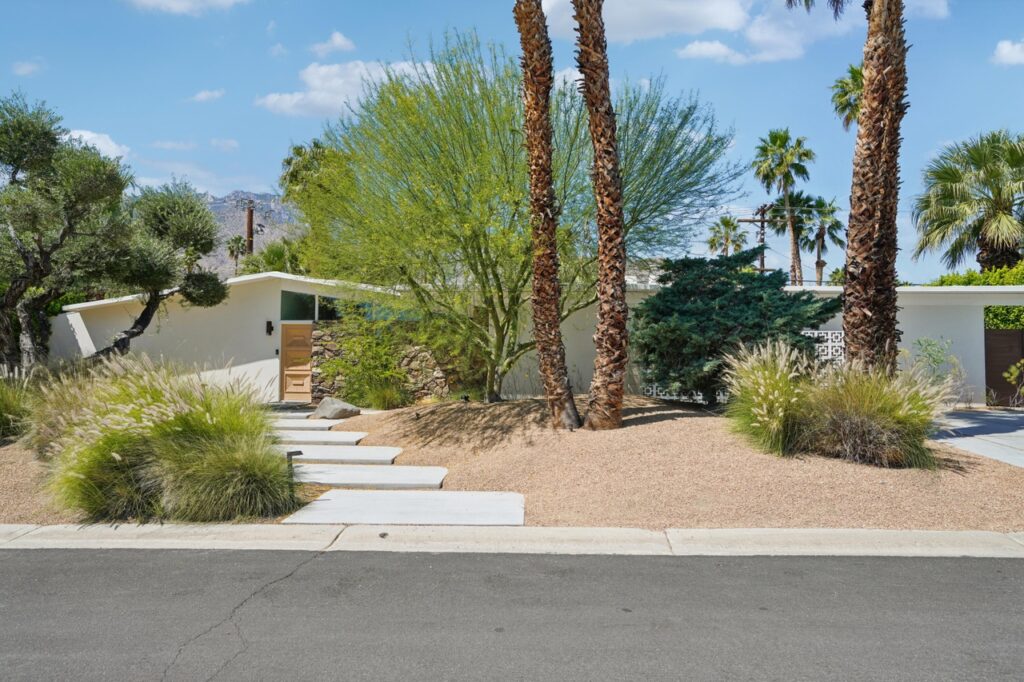
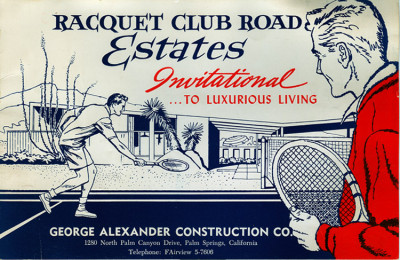
The Racquet Club Road Estates development comprised 360 homes — the Alexanders’ largest single-family tract ever — and they were designed by architect William Krisel of the firm Palmer & Krisel. Krisel gave buyers two basic floor plans: the “A” plan with a side-facing front door, and the “B” plan with a street-facing entry. Five different roofline options were layered over these plans to keep the streetscape from looking repetitive. The result was a tract of homes that felt genuinely diverse — unified by shared design principles (butterfly roofs, clerestory windows, post-and-beam construction, walls of glass, open carports, and concrete block details) but varied enough that no two blocks looked exactly alike. Original prices started around $16,000.
Critically, the Alexanders streamlined their process by storing materials on-site in a warehouse Krisel himself designed, so homes could be completed rapidly. The whole development was built and sold between 1959 and 1962 — a remarkable pace that speaks to just how hot the Palm Springs second-home market had become.
Enter Jack Meiselman
Jack Meiselman, as he often did, watched where the Alexanders were building and built homes adjacent to theirs. His homes in Racquet Club Estates are concentrated primarily near the neighborhood’s southern boundary, with documented addresses on Jacques Drive, Berne Drive, Starr Road, Milben Circle, and portions of North Via Miraleste. True to the Meiselman pattern, these weren’t large tracts — he built one or two homes at a time, scattered among the Alexanders, which is exactly why they’re so easy to miss and so satisfying to find.
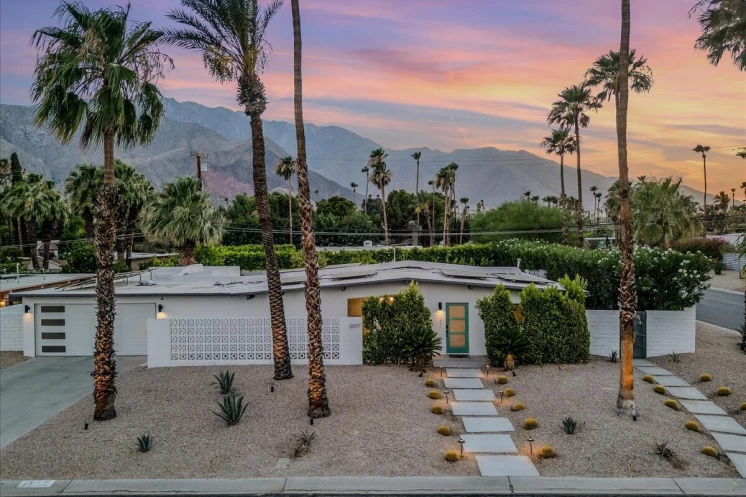
Meiselman homes in Racquet Club Estates share the DNA of his work across Palm Springs: butterfly and flat rooflines, post-and-beam ceilings, abundant windows and sliding glass doors, and a galley-style kitchen layout that differs subtly from the Alexander floor plans. The master suite placement is also distinctive: Meiselman typically separated the primary bedroom from the secondary bedrooms for privacy, while Alexander/Krisel plans tended toward a more linear arrangement. These are the small differences that obsessive Registry documentation exists to capture.
The Seven Steel Houses: An Architectural Legend
Near the northwestern corner of the neighborhood sits one of the most extraordinary collections of residential architecture in the United States: the seven Steel Development Houses designed by Donald Wexler and his partner Richard Harrison between 1961 and 1962. Commissioned by the Alexander Construction Company and sponsored by U.S. Steel, the project was originally intended to be 38 prefabricated all-steel homes. Wexler and structural engineer Bernard Perlin developed a system using factory-fabricated components that could be assembled on-site in days — a genuinely revolutionary approach to desert homebuilding.
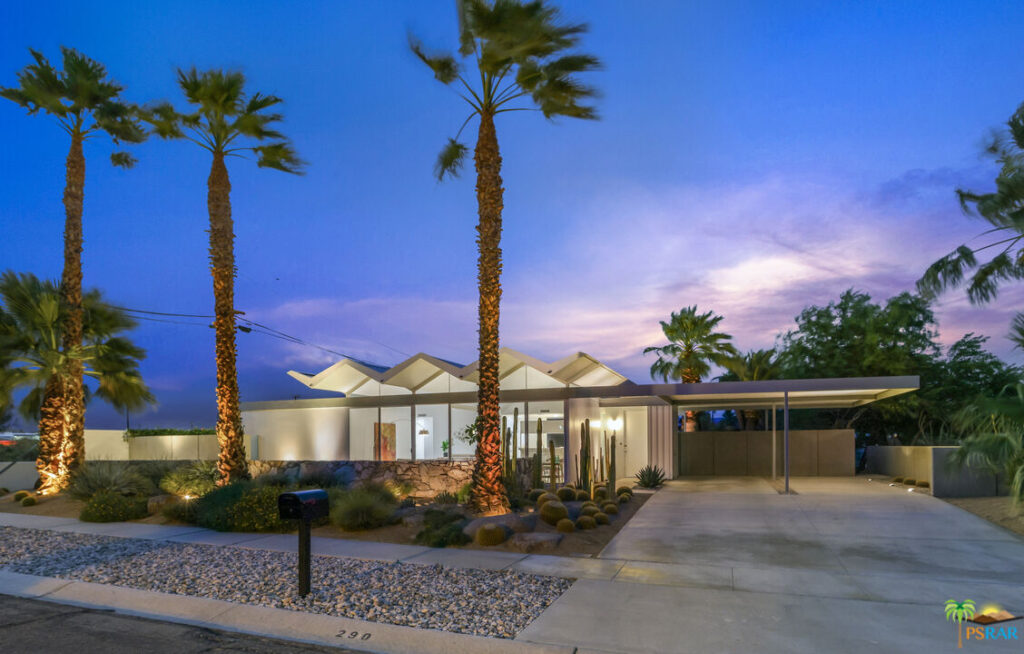
Only seven homes were completed before rising steel costs killed the program. The remaining lots were eventually used for the Alexanders’ “All Seasons” ranch homes, designed by the firm of L.C. Major and Associates, which brought a distinctly Polynesian flavor to the northwest corner of the neighborhood. But those seven steel homes? They’ve become internationally acclaimed. All seven have been designated Class 1 Historic Sites by the City of Palm Springs — the first midcentury residential structures in the city to receive that designation. Each features flat roofs, floor-to-ceiling glass panels eight feet high, and that seamless indoor-outdoor flow that defines Desert Modernism at its most ambitious.
End of an Era
The club itself was later designated a Class 1 Historic Site by the city. Unfortunately, in 2014, a devastating fire gutted much of the property. As of this writing in 2026, the 10-acre site remains vacant. Its future is the subject of ongoing discussion — a genuine preservation story in progress.
2,661 Residents and a Neighborhood That Knows Who It Is
With a census population of approximately 2,661 residents, Racquet Club Estates is the most populated of the neighborhoods the Meiselman Registry documents — and among the most active. The Racquet Club Estates Neighborhood Organization (RCENO) is one of the most engaged community organizations in Palm Springs, with a long history of Modernism Week home tours, charitable giving, and advocacy for the neighborhood’s architectural character.
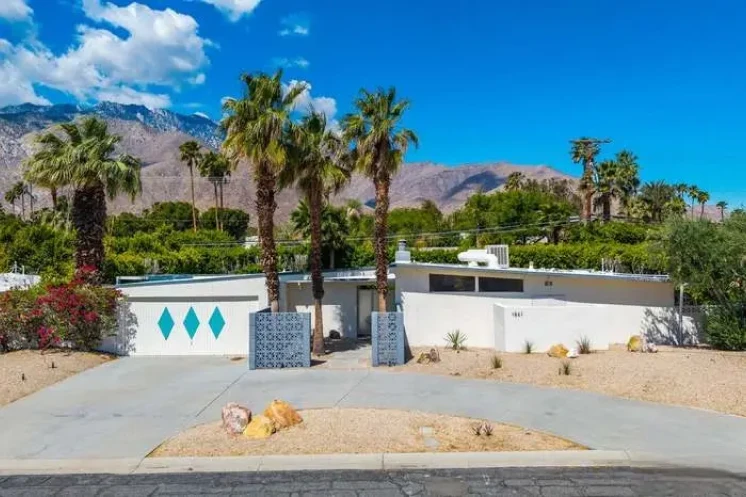
The homes here are exclusively single-family residences — no condo communities or apartment buildings within the neighborhood boundary, which gives Racquet Club Estates a residential consistency that’s increasingly rare in Palm Springs. Most homes are set on generous lots, mostly on fee simple land with no HOA, and range from roughly 1,200 to nearly 2,900 square feet. The architectural mix encompasses Krisel-designed Alexanders, Meiselman homes, the seven Wexler steel houses, and the All Seasons ranch homes — a concentration of named, documented Desert Modernism that makes this neighborhood a kind of living textbook.
The neighborhood’s renaissance has been well-documented. When Palm Springs real estate dipped in the 1980s, many of the vacation homes were simply locked up and left — untouched, which turned out to be a gift. A new generation of buyers rediscovered them in the 1990s and 2000s, and the careful restoration work that followed created the neighborhood visitors see today. There’s a reason Modernism Week’s Racquet Club Estates tours consistently sell out: this is the neighborhood where the story of Desert Modernism is most legibly told.
Racquet Club Estates and the Meiselman Registry
For the Meiselman Registry, Racquet Club Estates is essential and ongoing territory. This is one of the neighborhoods where Jack Meiselman’s independent development work is most concentrated outside of Sunrise Park, and where his scattered-site building strategy is most evident — one or two homes at a time, quietly placed among hundreds of Alexanders, waiting to be correctly identified and documented. The Registry’s work here matters precisely because Meiselman homes are rarer than Alexanders and often misattributed. Getting them right is the whole point.
If you’re walking these streets for the first time, go slowly. Watch for the slightly shorter clerestories. Notice the master suite tucked away from the rest of the bedrooms. Look for the galley kitchen through the windows. That’s a Meiselman. And now you know what you’re looking at.
Have a Meiselman home in Racquet Club Estates? We’d love to feature your property in the Registry. Register your home
Leave a Reply