Part 2 - The Search: Finding "The One" in Palm Springs
It was February, Modernism Week in Palm Springs, and Susan and I were walking through our fourth midcentury modern home of the day. The double-height ceilings were impressive, the butterfly roof was iconic, but something felt off. Maybe it was the busy street out front, or the tiny lot, or the fact that the backyard had views of nothing but a cinderblock wall. We thanked the realtor and stepped back into the brilliant desert sunshine, slightly discouraged but not defeated.
We’d come to Palm Springs as guests of friends who’d been attending Modernism Week for years. They’d regaled us with stories of architecture tours, cocktail parties in impeccably restored Alexander homes, and the infectious energy of thousands of design enthusiasts converging on this desert oasis. “You have to experience it,” they’d said. They were right.
The Midcentury Modern Bug Bites Hard
Susan and I have always loved midcentury modern architecture and design. Our home in the suburbs of Chicago is a late-MCM ranch—nothing fancy, but it has the clean lines, open floor plan, and walls of glass that drew us to the style in the first place. We’ve decorated it with vintage pieces, added period-appropriate lighting, and done our best to honor its 1970s origins while making it work for contemporary life.
But Palm Springs? Palm Springs is the epicenter, the mother lode, the place where midcentury modern isn’t a niche interest but a way of life. Here, Alexander Construction Communities sprawl across entire neighborhoods. William Krisel’s butterfly roofs punctuate the skyline. Donald Wexler’s steel houses gleam in the desert sun. And architects like Jack Meiselman created hundreds of elegant, livable homes that somehow feel both of their time and timeless.
We’d dreamed of having a classic MCM home in Palm Springs—not just as a vacation house, but as a second home where we could escape Chicago winters, immerse ourselves in the design community, and maybe even generate some rental income when we weren’t there.
What sealed the deal wasn’t just the architecture, though. It was the people. Everyone we met during that first visit—from restaurant servers to docents at architecture tours to fellow enthusiasts waiting in line for lectures—was friendly, interesting, and genuinely passionate about the place they called home. Palm Springs felt like a community we wanted to be part of.
By the end of Modernism Week, we’d made a decision: we were going to buy a home here.
Getting Serious: Creating Our Criteria
We’re both planners by nature, so before we started seriously house hunting, we sat down and created a detailed list of criteria that any potential home would have to meet. We’d learned from our Chicago purchase that knowing exactly what you want—and what you’re willing to compromise on—saves enormous amounts of time and prevents you from falling in love with homes that won’t actually work for your needs.
Here’s our list:
- A neighborhood that qualifies for short-term rental permits: We wanted rental income potential, but Palm Springs has strict regulations about where short-term rentals are allowed. This immediately narrowed our search.
- Not on a busy, noisy street: We wanted to hear birds and rustling palms, not traffic.
- A midcentury modern neighborhood: We wanted the entire neighborhood to give off that classic midcentury modern vibe.
- 3 bedrooms: Non-negotiable. Two for guests, one for us.
- 2 bathrooms: Minimum. We’d learned that single-bathroom homes, while common in MCM designs, create stress when you have guests.
- At least 1,200 square feet of living area: Large enough to feel spacious, small enough to feel cozy and manageable.
- At least 8,000 square feet lot size: We wanted room for outdoor living—a real backyard, not just a postage stamp of concrete.
- Pool and spa: Essential for Palm Springs living and rental appeal.
- Enclosed backyard: Privacy matters, especially if we’re renting the home.
- Iconic midcentury modern features: Post-and-beam construction, clerestory windows, walls of glass, open floor plan—the real deal, not a ranch house pretending to be MCM.
- Iconic midcentury profile from the street: We wanted a house with curb appeal that makes you know you’re looking at something special.
- Less than $900,000 purchase price: We had a budget, and we were determined to stick to it.
- Mountain views from the backyard and from the pool: One of Palm Springs’ greatest assets is its dramatic setting. We wanted to enjoy the views from every part of our yard.
- Mature palm trees on the property: Nothing says Palm Springs like a sixty-foot palm tree casting shadows across your patio.
- Livable at closing, wouldn’t need a complete rehab: We wanted a project, but not a disaster. We needed to be able to use the house while we slowly and thoughtfully restored it.
Looking back, this was an ambitious list. We were essentially looking for a near-perfect home at a below-market price. But we figured if we were patient and thorough, we’d find it.
The First Search: Modernism Week House Hunting
Armed with our criteria and the Realtor.com app, we spent our Modernism Week evenings scrolling through listings. We must have viewed over a hundred properties online, eliminating most immediately because they were in the wrong neighborhood, too expensive, lacked a pool, faced the wrong direction, or lacked that special something that makes a midcentury modern home sing.
We scheduled tours of six houses with different realtors, wanting to get a feel for both the market and the professionals who worked in it. Each home taught us something new about what we were really looking for.
There was the Krisel with the amazing butterfly roof that had been “updated” with granite countertops and Mediterranean tile. There was the Alexander that checked every box except price—listed at $1.2 million with no room for negotiation. There was a charming three-bedroom home with a great pool and two spas, but it didn’t have mountain views, and the neighborhood wasn’t 100% midcentury modern.
And then there was the Steel House by Donald Wexler.
If you know Palm Springs architecture, you know the Steel Houses are legendary—an experiment in prefabricated steel-frame construction that resulted in some of the most iconic homes in the desert. Standing in that house, with its folded roofline, floor-to-ceiling glass, and impeccable restoration, we felt the pull. This was a home that we had admired for years in books and magazines, and we loved the thought of owning an iconic piece of midcentury modern architecture.
However, there were three problems: it had only two bedrooms, it offered poor views of the mountains, and it was priced at $1.5 million. As much as we loved it, it didn’t meet our criteria, and we’d promised ourselves we wouldn’t compromise on the essentials.
We flew back to Chicago without making an offer on anything, slightly disappointed but not discouraged. We knew finding “the one” might take time.
The Second Trip: Six More Houses and No Luck
A few months later, we returned to Palm Springs for another round of house hunting. We’d continued monitoring the market from afar, and several promising properties had come on the market. We scheduled tours of six more houses, optimistic that this trip would be the one.
It wasn’t.
Each house had something wrong with it. By our last afternoon in Palm Springs, we were packing our bags and preparing to head to the airport, resigned to the fact that we’d be making yet another trip before finding our perfect home. Susan was in the hotel room packing.
On a whim, I decided to take one last drive through the three neighborhoods we’d been focusing on—Sunmor, Oasis del Sol, and Sunrise Park. I just wanted to soak up the vibe one more time before heading home.
Love at First Sight (Almost)
That’s when I saw them: three “Open House” signs in front of three different houses. I hadn’t seen any of these properties listed online, which meant they were either brand-new listings or I’d somehow missed them in my searches.
The first two didn’t fit our criteria, but then I pulled up in front of 606 Monterey Road.
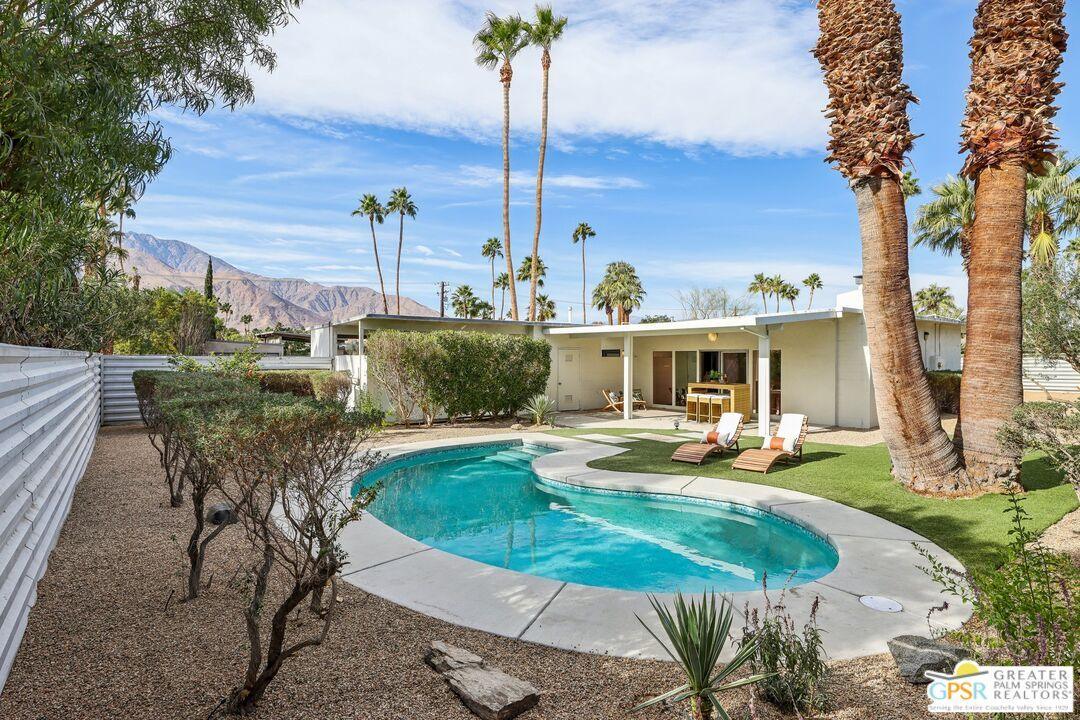
The profile from the street was perfect—low-slung, clean lines, a distinctive roofline that was clearly original. Mature palm trees framed the property. The neighborhood was quiet, fully midcentury modern, exactly what we’d been looking for. I felt that flutter of excitement that you get when you think you might be onto something.
I walked through the front door and immediately knew this was different.
The living room opened before me with high, 9-foot-tall post-and-beam ceilings, a wall of floor-to-ceiling windows flooding the space with light, and looked out onto a small but beautiful teardrop-shaped pool. When I walked outside, the view stopped me in my tracks. The San Jacinto Mountains rose dramatically beyond the pool, palm trees swayed in the breeze, and the entire backyard was bathed in that golden late-afternoon light that makes Palm Springs magical.
The agent, Sarah Pierce, greeted me, and I walked through, checking off items on our checklist in my mind. Three bedrooms: check. Two bathrooms: check. Open floor plan with original features intact: check. Pool check, but no spa. Mature landscaping: check. The house was dated, sure—the kitchen had been updated in the 90’s but was still dated. The bathrooms needed work, and the flooring was a mix of broken stone time that wasn’t original and old dirty carpet—but it was livable. More importantly, it was authentic. This was a real midcentury modern home, not someone’s interpretation of one.
Best of all, the asking price was in our budget—just barely, but it was doable.
I called Susan immediately. “Drop what you’re doing, I think I found a house you’re going to love.”
Fifteen minutes later, Susan walked through the front door, and I watched her face go through the same progression mine had: curiosity, interest, surprise, and then that serious interest.
We spent an hour with Sarah, asking questions, recording a video walk-through tour & taking photos, discussing the neighborhood, and learning as much as we could about the home’s history. It had been built by Jack Meiselman in 1960, one of over three hundred homes he’d constructed in Palm Springs. The current owners had used it as a rental property for the last 10 years, and were now ready to sell.
Before we left, we told Sarah we loved the house but wanted to think about it. This is negotiation 101: always be prepared to walk away.
The Offer
We flew back to Chicago that evening, our minds racing. We spent the next week analyzing everything: the neighborhood, the comps, the rental potential, the renovation scope, the cost of bringing the house up to our standards. We created spreadsheets, made lists, and had long conversations about whether this was really the right move.
After each analysis, we came closer to feeling this was the right decision.
A week later, Sarah called with news: the sellers were motivated and willing to reduce the price by $50,000. This was our moment.
We submitted an offer $10,000 below the reduced asking price, bracing ourselves for a counteroffer or an outright rejection. Instead, after one day of negotiation, they agreed to accept.
We’d found our Meiselman for $840,000, down from the $990,000 it was initially listed at.
The Unexpected Market Twist
There’s a postscript to this story that’s worth sharing, even though it’s a bit painful. Three months after we closed on 606 Monterey Road, Donald Trump took office, and the Palm Springs real estate market underwent a dramatic shift. Many foreign homeowners—mostly Canadians who’d been major players in the Palm Springs market—decided to sell their properties. The result was a sudden influx of inventory, resulting in a 20% drop in prices.
If we’d waited just three more months, we could have saved a significant amount of money.
Now, prices have largely recovered, and we love our home, so in the grand scheme of things, it doesn’t matter. But it’s a reminder that real estate markets are unpredictable, especially in resort communities with significant foreign ownership. Timing matters, and sometimes you win and sometimes you lose based on factors entirely beyond your control.
Key Takeaways
As we look back on our search process, several lessons stand out:
Create a detailed set of acquisition criteria: Knowing exactly what you want—and what’s non-negotiable versus nice-to-have—will save you enormous amounts of time and prevent you from getting distracted by homes that won’t actually work for your needs.
Take your time; there are lots of options out there: We looked at hundreds of homes online and toured more than a dozen in person before finding the right one. It would have been easy to settle for something good enough, but we’re so glad we waited for something great.
Palm Springs real estate goes through big swings, so timing can make a difference: If you want to get a great deal, pay attention to market cycles. We bought at a decent time, well down from the COVID peaks when Palm Springs real estate skyrocketed, but our timing was not perfect. If we had waited three months, we could have saved a lot of money, but waiting also carries the risk of losing the right property. There’s no perfect answer here, just the reality that market timing matters.
Don’t ignore open houses: We found our home almost by accident, driving through neighborhoods on our last afternoon in town. So drive through the neighborhoods that interest you. Sometimes luck plays a role, but you have to be out there looking to let luck happen.
Trust your gut: Within minutes of walking into 606 Monterey Road, we both knew this was the one. All the spreadsheets and analyses in the world can’t replicate that feeling of rightness you get when you walk into a space that just works.
The next step is to test whether that gut feeling is backed up by reality: due diligence and home inspections. In the next installment, we’ll share what we learned when we looked beyond the stunning views and gorgeous profile to examine what was really going on with the structure, systems, and bones of our Meiselman home.
Spoiler alert: there were more than a few surprises!