Part 7 - Landscaping for Desert Modernism: Xeriscaping with Style
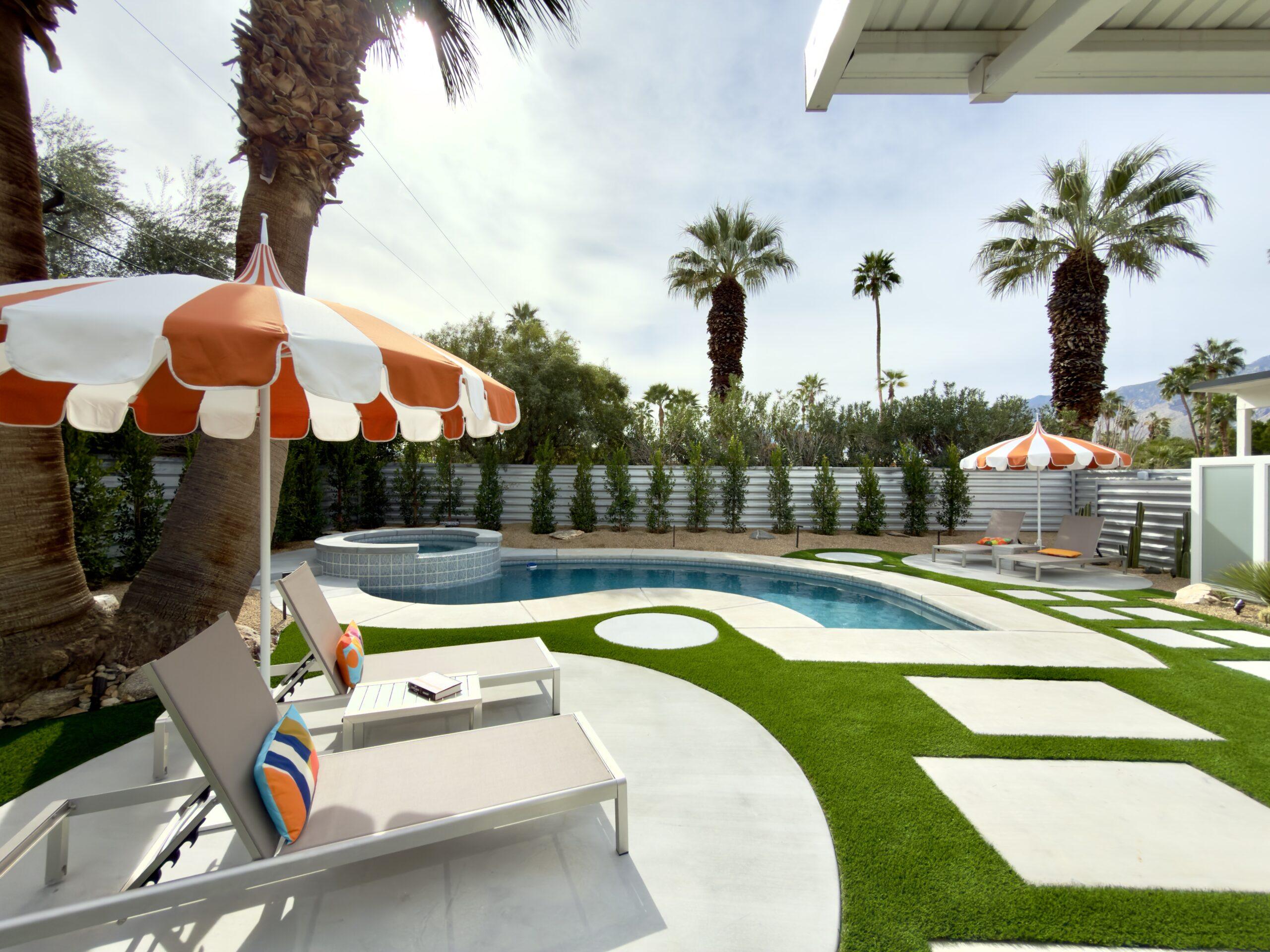
If you’ve ever looked at photos of iconic Palm Springs midcentury modern homes, you know that the landscaping is never an afterthought. Those carefully composed scenes of architectural perfection—the low-slung rooflines, the walls of glass, the organic pools—are always framed by equally thoughtful landscaping. Desert plants with dramatic forms. Gravel beds that echo the texture of the surrounding mountains. Boulder groupings that feel inevitable, as if they’d always been there.
The landscape isn’t just decoration in a midcentury modern home. It’s an essential part of the design, the element that mediates between architecture and nature, between the controlled geometry of the house and the wild beauty of the desert.
Susan and I understood this intellectually, but translating that understanding into an actual landscape design for our property proved to be one of the most challenging aspects of our entire restoration.
Starting with Vision: What Did We Actually Want?
Before we started looking for a landscape designer, we did what had worked well for us throughout the restoration: we created a clear vision statement and a detailed list of criteria.
We knew we wanted a landscape that felt authentically desert modern—not the overly manicured, golf-course aesthetic that some Palm Springs properties have, but something that honored the natural environment while creating functional outdoor living spaces.
Our specific requirements included:
- Areas for four chaise lounge chairs around the pool. This was non-negotiable. We wanted to be able to relax poolside with friends without feeling cramped.
- Additional covered area for a six-person dining table and chairs. Outdoor dining is central to the Palm Springs lifestyle, and we needed a shaded space where we could comfortably eat during the intense midday heat.
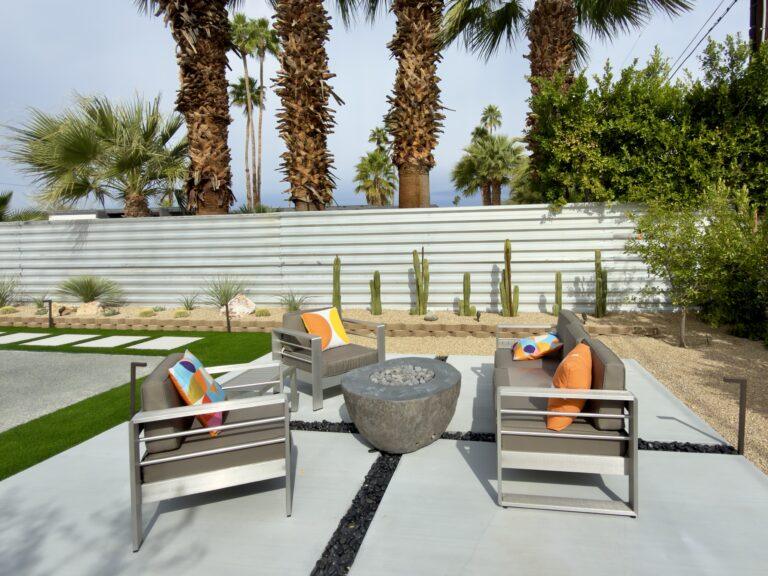
- Fire pit area with seating for six. Desert evenings are magical, and we wanted a gathering space where we could enjoy them.
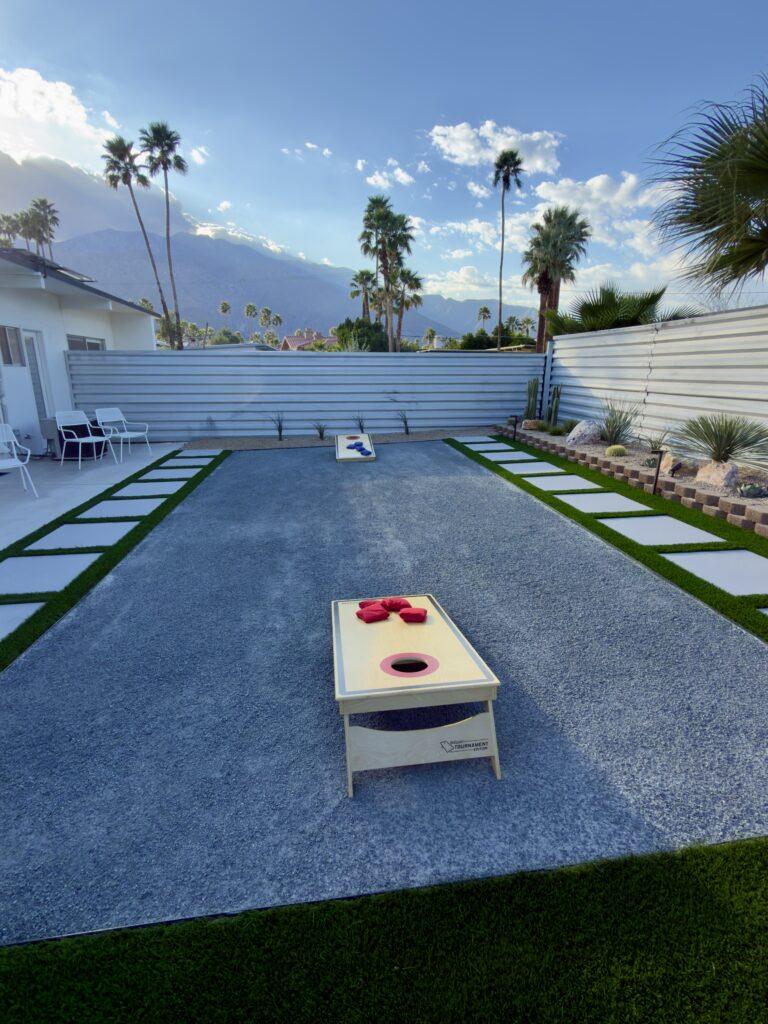
- Play area for bocce ball, cornhole toss, and ping pong. We envisioned a flat, defined space that could accommodate yard games—a casual, fun element that would make the backyard feel welcoming and livable.
- Quiet area under the olive trees for morning coffee and reading. Not every outdoor space needs to be social. We wanted a contemplative corner for solo time.
- Space for an outdoor kitchen. We were already planning to install a Mont Alpi grill and refrigerator, and the landscape needed to accommodate and integrate this element.
- Use of a variety of shapes and textures that all coordinate. Successful desert landscaping is about layering different plant forms—the vertical thrust of ocotillo, the rounded mass of barrel cacti, the spreading form of agave, the feathery texture of desert grasses. We wanted visual interest without chaos.
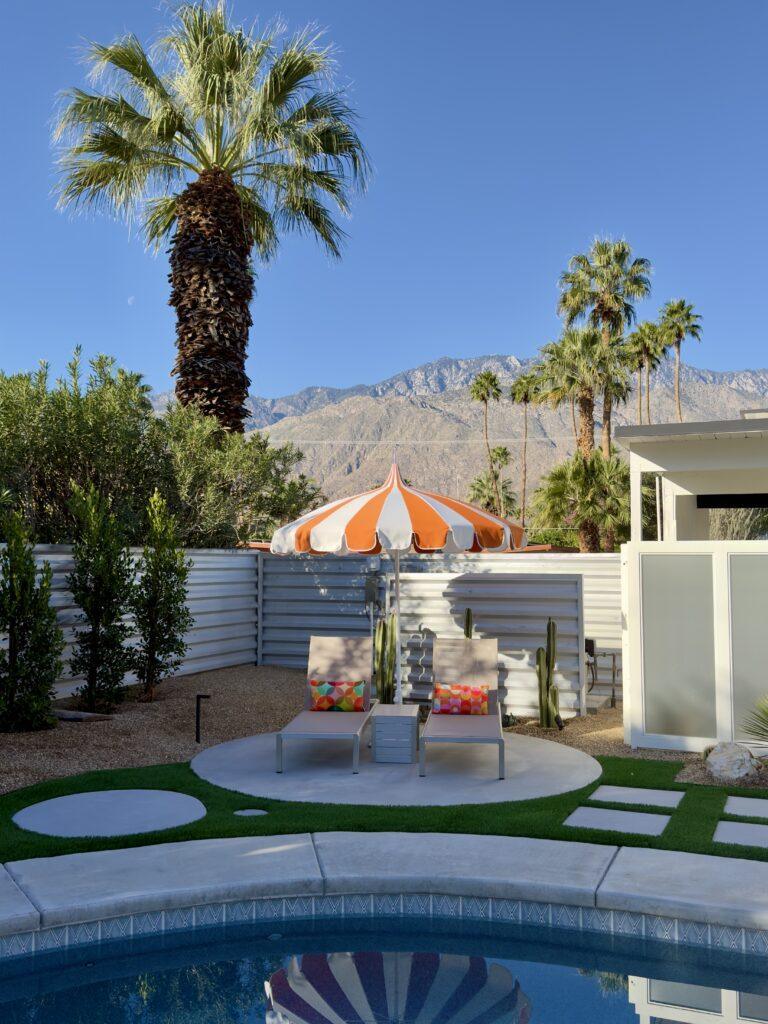
- Take advantage of the mountain views. This was critical. Our property had spectacular views of the San Jacinto Mountains from both the poolside and the rear of the house. Any landscape design that blocked or diminished those views would be a failure.
We also compiled a list of specific plants we’d fallen in love with during our time in Palm Springs: various desert grasses, various agave species, barrel cactus, ocotillo, Mexican fence posts, and mature olive trees.
With our criteria established, we set out to find someone who could turn this vision into reality.
The Search for a Designer: Harder Than Expected
This might surprise you, but finding a landscape designer who specialized in desert modernism and was willing to work with us proved to be one of the most difficult aspects of the entire restoration.
We scoured the Internet looking for designers whose portfolios demonstrated an understanding of midcentury modern aesthetics and desert ecology. We found several whose work we admired and reached out to four of them.
The results were discouraging. One only worked on much larger projects—essentially, he had a minimum budget that was well above what we planned to spend. Another had retired from residential work. A third was now focused exclusively on more lucrative commercial projects. The fourth never returned our calls.
This pattern would repeat itself several times. The most talented designers in Palm Springs were either too busy, too expensive, or simply not interested in residential projects at our scale.
Designer Number One: Creative but Not Compatible
Eventually, we found a designer who seemed promising. He’d been active designing residential landscapes in Palm Springs for twenty years, and his portfolio showed creative, thoughtful work. We scheduled an appointment.
From the beginning, there were yellow flags, but we chose to overlook them because we were eager to move forward. The first issue: he would not disclose his design fees upfront. He stated that they were “included in the total project cost,” which is industry-speak for “I’m marking up everything and not being transparent about my compensation.” We told him our budget clearly from the start, hoping that would keep things on track.
He also didn’t have a design contract—another red flag. Professional designers should always work with clear contracts that spell out deliverables, timelines, and compensation.
But we pushed forward, hoping these concerns were minor.
Over the next two months, we worked with him to develop initial designs. This is where the real incompatibilities emerged. He was very traditional in his working methods—he wasn’t comfortable with Zoom meetings or working with clients who were remote and in different time zones. Given that we were based in Chicago and could only visit Palm Springs periodically, this created constant friction.
He also wasn’t very organized. We found ourselves regularly following up to see how he was progressing, chasing him for updates, and trying to keep the project moving forward. This shouldn’t be the client’s job—a professional designer should be managing the process and keeping you informed.
After two months, he finally provided a proposal for implementing his design.
It was approximately 35% over our budget. And it didn’t include several key items from our original list—including the shade structure over the dining table and proper integration of the outdoor kitchen area.
Most problematically, his design included four large trees surrounding the bocce ball court that would block our mountain views from the fire pit seating area. When we first met him, we emphasized that the views were one of the primary reasons we’d fallen in love with this property—he nodded and took notes. But his design ignored this fundamental requirement.
We asked him to revise the proposal to include the missing items, identify cost savings to bring it within budget, and remove the view-blocking trees.
He became defensive. He pushed back and seemed offended that we were questioning his design choices. It was clear that he didn’t appreciate clients who wanted to be actively involved in the design process.
We realized that while he was indeed creative, he wasn’t a good fit for how we worked. We needed someone who was collaborative, someone who listened, and someone who could work remotely and stay organized. We parted ways—cordially, but definitively.
After two months of effort and no usable design, we were back to square one.
The Solution Was Right in Front of Us
At that point, I had a realization: we’d been so focused on finding a “name” designer with an impressive portfolio that we’d overlooked the most obvious resource.
Vicente Diaz, the landscaper who’d been maintaining the property since before we bought it, was someone we already knew and trusted. He understood the property, he knew the neighborhood, and he’d been working in Palm Springs for years. If anyone would know a good landscape designer, it would be Vicente.
I called him and asked if he could refer us to someone. Without hesitation, he recommended Nestor Diaz (no relation, despite the shared last name).
Nestor came to look at the property, and we walked him through our criteria list and showed him some of the ideas we’d refined during our work with the first designer—the elements that had worked, even if the overall design hadn’t.
Within a week, Nestor had a complete set of plans for us to review.
They were exactly what we were looking for. We made a few minor revisions, which Nestor turned around quickly and we were done.
He’d incorporated all of our requirements. The views were preserved. The plant selections felt authentically desert modern—native species with dramatic forms, layered textures, and colors that would provide year-round interest. The functional spaces we needed were clearly defined but integrated seamlessly into the overall design. The bocce ball court was perfectly positioned. The fire pit area felt intimate but not cramped. The olive tree reading corner looked like a secret garden.
Best of all, Nestor charged a flat fee for his design work—less than $1,000. No hidden markups, no vague “included in the project cost” language. Just straightforward, transparent pricing for professional design services.
We gave the plans to Vicente, who put together an implementation proposal that was within our budget. After months of frustration, we finally had a path forward.
The Budget and What It Covered
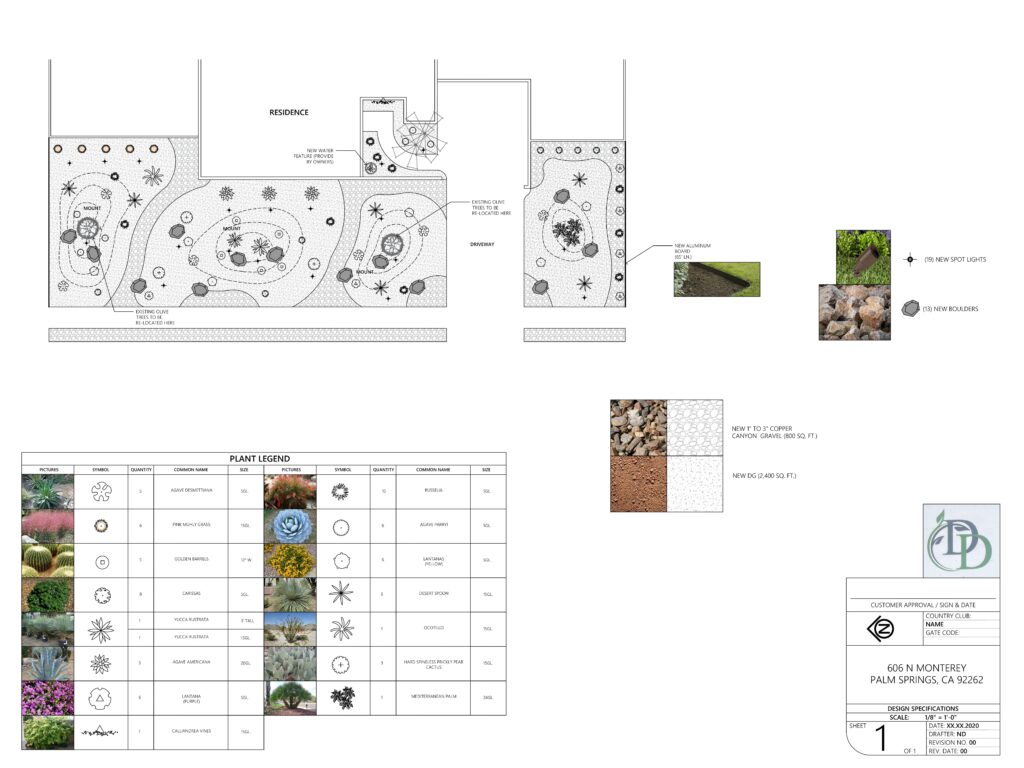
We divided the landscaping project into two phases: front yard and backyard.
Front yard budget: $20,000
This included all new plants selected for their desert-appropriate, low-water characteristics; new decorative gravel to replace worn materials; new landscape lighting that would highlight the house’s architectural features at night; and a new irrigation system designed for water efficiency.
The front yard is what visitors see first—it’s the frame for that iconic midcentury profile we’d fallen in love with. We wanted it to look polished and intentional while still feeling natural and relaxed.
Backyard budget: $50,000
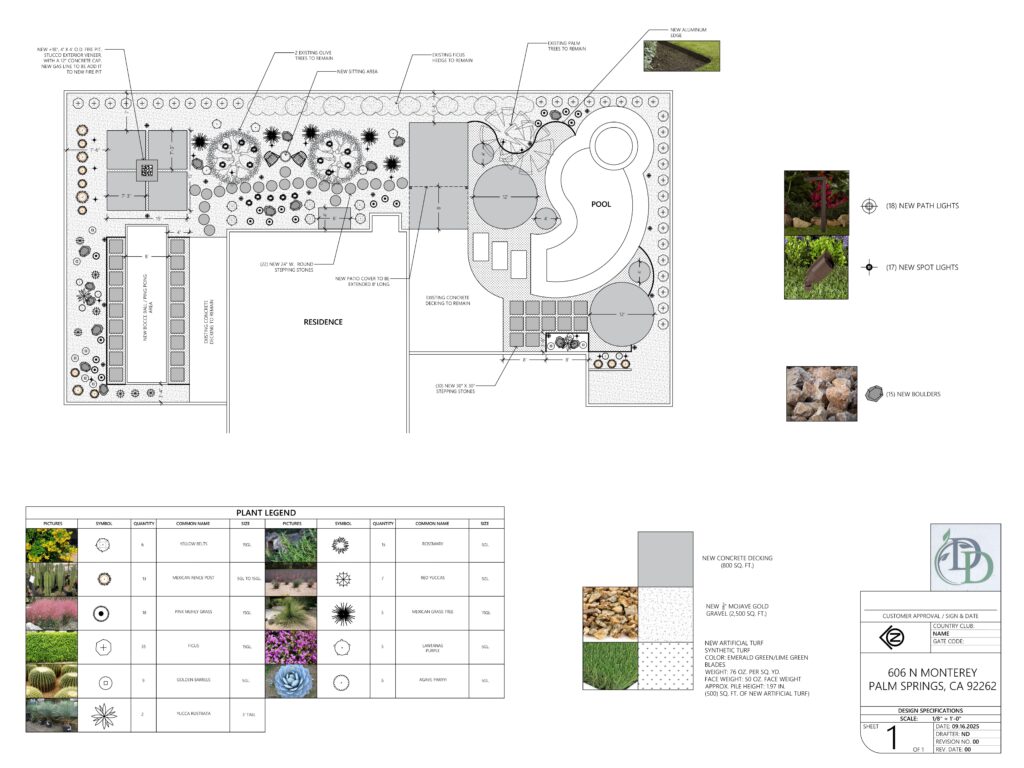
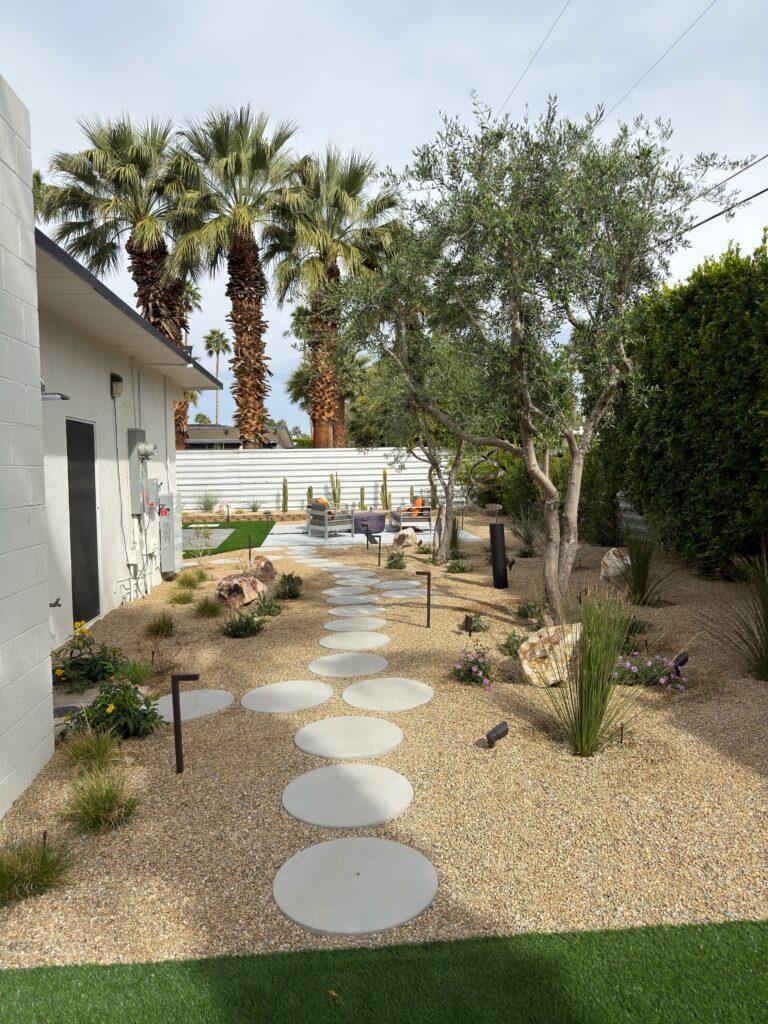
This was where the real transformation would happen. The budget covered all new plantings, including mature olive trees and specimen desert plants; new decorative gravel and carefully placed boulders that echoed the mountains beyond; new landscape lighting throughout; a new irrigation system; a custom fire pit with built-in seating; a bocce ball court that could also accommodate cornhole toss and ping pong; the olive tree seating area with appropriate understory planting; 200 square feet of new concrete pad for the outdoor kitchen area; and sections of artificial turf in high-traffic areas where maintaining natural grass would be impractical.
The backyard needed to be both beautiful and functional—a space where we could lounge by the pool, entertain friends, play games, cook outdoors, and simply enjoy the desert environment we’d moved here to experience.
Total landscaping budget: $70,000.
This represented a significant investment, but landscape is one area where cutting corners shows immediately and permanently. A poorly designed or cheaply executed landscape can undermine even the most beautiful architecture. We were restoring a midcentury modern gem, and it deserved landscaping that lived up to its pedigree.
Key Takeaways
Our landscape design journey taught us several valuable lessons:
Know what you want before you start. Having clear criteria saved us from being talked into designs that wouldn’t have worked for how we actually live. Don’t assume the designer knows better than you do what you need from your outdoor spaces.
Interview several designers. Don’t commit to the first person you find, even if their portfolio looks good. Compatibility matters as much as creativity.
Find out how they work and if they’re comfortable working with you the way you do business. If you’re remote, you need someone who’s comfortable with virtual meetings and digital communication. If you’re hands-on, you need someone who welcomes collaboration rather than viewing it as interference.
Have a clear understanding of the designer’s fees and how they get paid. Is it a flat fee, an hourly rate, or a percentage of the overall project cost? Insist on transparency. Vague answers about fees being “included” are a red flag.
Understand how quickly they can turn around designs. A good designer should be able to produce initial concepts relatively quickly—within weeks, not months. If the process is dragging on indefinitely, something’s wrong.
Understand if they’re a general contractor who will supervise implementation, or if they just provide the design. This affects cost, timeline, and who’s responsible for what. We ended up with a designer who provided plans and a separate contractor (Vicente) who implemented them—a model that worked well for us.
Don’t overlook local knowledge. The best resources are often right in your community. Vicente’s recommendation of Nestor proved to be exactly what we needed, and we’d wasted months looking elsewhere first.
Budget appropriately for landscaping. It’s not cheap, especially if you’re doing it right. Plan for this expense from the beginning rather than treating it as an afterthought.
Remember that landscaping is an investment that matures over time. Unlike interior finishes that look their best the day they’re installed, landscapes get better as plants establish and mature. You’re not just buying plants—you’re creating an evolving environment.